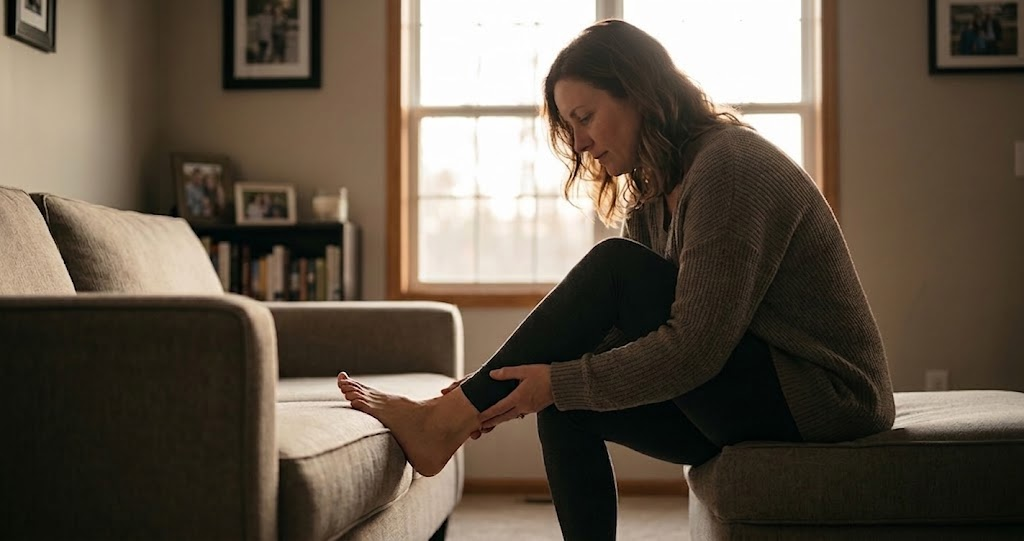
Hot, Shooting Pain From Your Hip Into Your Calf When You Drive: What It May Mean, and Where to Start in OKC
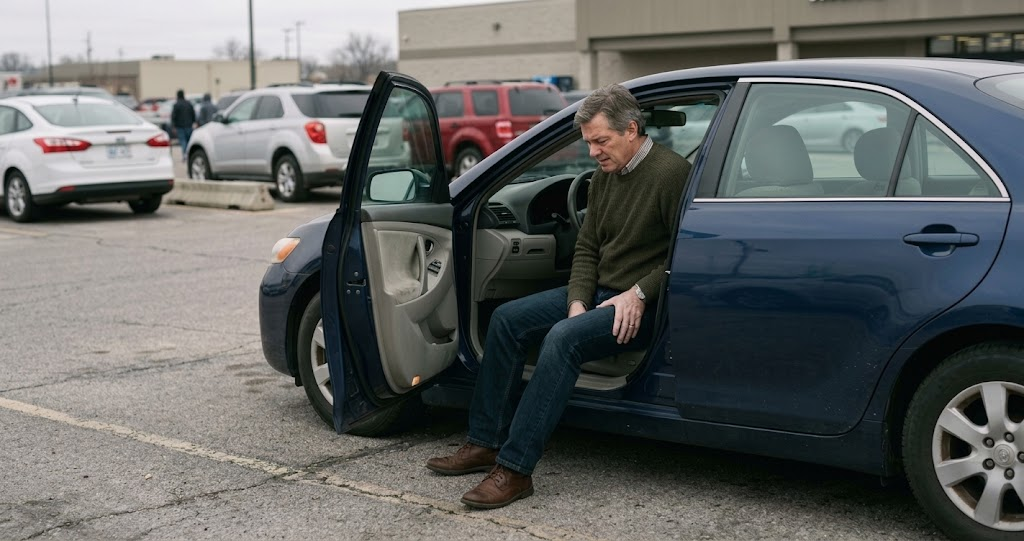
Almost every driver with an aching back assumes it will pass. Hot, electrical pain that shoots from the hip into the calf while driving is a different signal, and it deserves a straight answer, not a guess.
Hot, electrical pain that shoots from your hip into your calf while driving may suggest irritation involving the lower back or spinal nerves, but it cannot be diagnosed from symptoms alone, no matter how specific the pattern feels. As Dr. Betty Bampoe puts it, a thorough evaluation can help determine what may be contributing to your symptoms and whether conservative chiropractic care, additional imaging, spinal decompression, rehabilitation, or referral to another provider is the most appropriate next step. Driving is a genuine mechanical trigger, not an imagined one: a 2015 systematic review and meta-analysis in the International Archives of Occupational and Environmental Health found whole-body vibration exposure — the kind produced by a moving vehicle — associated with more than double the odds of low back pain and sciatica among exposed workers (Burström, Nilsson & Wahlström, 2015, pooled odds ratio 2.17).
What Does Dr. Betty Listen For When Pain Shoots From the Hip Into the Calf While Driving?
Dr. Betty listens for the pattern more than the words. Three details matter most: does the pain follow a line down the back or side of the leg, past the knee, rather than sitting in one general area? Is it sharp or electrical rather than a dull ache? Does it come with numbness, tingling, or weakness in the foot? Those details help distinguish nerve irritation from a muscular issue, but they narrow the question rather than answer it — those answers guide the evaluation, they do not replace it.
Pain that shoots from your hip into your calf when driving may suggest irritation involving the lower back or spinal nerves, but it cannot be diagnosed based on symptoms alone. A thorough evaluation can help determine what may be contributing to your symptoms and whether conservative chiropractic care, additional imaging, spinal decompression, rehabilitation, or referral to another provider is the most appropriate next step.
Why Does Sitting or Driving Make Shooting Leg Pain Worse?
Driving combines two things at once: a fixed hip angle held for an extended period, and mechanical vibration transmitted through the seat. Chiropractors have long been taught that sitting itself raises pressure inside the lumbar disc more than standing does; more recent biomechanical research has actually complicated that specific claim, finding smaller and less consistent differences than once assumed, particularly in discs that already show wear.
What the occupational research shows consistently is the effect of driving as a whole — posture, vibration, and duration together. The 2015 meta-analysis referenced above pooled data across professional drivers and found the combined exposure clearly associated with higher rates of low back pain and sciatica. In a metro area with long commutes and a large driving workforce, that occupational pattern shows up daily in this office. It tells us the trigger is common and worth evaluating. It does not tell us which structure is involved or how irritated it is — only an exam does that.
Which Symptoms Mean I Should Skip Waiting and Get Immediate Care?
Seek immediate medical evaluation if you develop:
- Loss of bladder or bowel control
- Numbness in the groin, inner thighs, or saddle area
- Rapidly worsening leg weakness
- A foot that suddenly cannot lift, so it drags or slaps the floor
- Severe symptoms following a major fall, crash, or trauma
- Fever or unexplained weight loss alongside new severe back pain
Those symptoms call for immediate medical evaluation, not a scheduled chiropractic visit. Go to an urgent care or emergency room, or call 911 if symptoms are severe.
Those symptoms point toward cauda equina syndrome, a nerve-compression emergency. A 2020 systematic review in the Journal of Neurosurgery: Spine (Hoeritzauer et al., 2020) found the condition is rare across the general population, but occurs clearly often enough among people who show its hallmark warning signs that emergency imaging is standard practice whenever those signs appear. Rare does not mean safe to wait on.
What Should I Do If This Pain Is Disrupting My Life but It Isn't an Emergency?
Schedule a conservative evaluation rather than waiting it out or trying to self-diagnose online. Many causes of radiating leg pain can be evaluated conservatively, and waiting has a quiet failure mode: the pain becomes something you plan your life around instead of something you address. A practical first step: take the OKC Sciatica Check at OKCSciaticaCheck.com before you call anyone — it takes a few minutes and helps Dr. Betty's team understand your pattern before your first visit.
What Happens During an Evaluation at Precision Care Chiropractic?
An evaluation starts with listening — how the pain started, what makes it better or worse, how it is affecting your daily life. Then comes orthopedic testing, reflex testing at the knee and ankle, strength testing in the leg and foot, sensation testing, and a look at posture and range of motion in the low back and hips. Each test is explained before it is done, and none of it is meant to hurt.
Only after that — your history, the exam findings, and any imaging you bring — does Dr. Betty talk with you about what may be contributing to your symptoms and what reasonable options look like. A patient should never feel like they were treated before anyone understood what was actually going on.
What Should I Bring to My First Visit?
The written report from any MRI or X-ray, the images themselves if you have them, notes on what you have already tried and how your body responded, and a rough timeline of when the pain started. That history lets Dr. Betty build on what is already known instead of starting from zero. Precision Care has digital X-ray on-site if imaging is clinically indicated early on; MRI is not performed in-office, and patients are referred to trusted imaging centers in the Oklahoma City area if one is needed.
How Is an Evaluation-First Approach Different From Guessing Based on Symptoms Alone?
| Guessing From Symptoms Alone | Dr. Betty's Evaluation-First Approach |
|---|---|
| Diagnosing from an online search or symptom description | History, orthopedic exam, neurological exam, and imaging review when available |
| Treating a recognizable pattern as if it were a confirmed diagnosis | Treating the pattern as a reason to evaluate, not a conclusion |
| Waiting until pain becomes severe before doing anything | Scheduling a conservative evaluation while symptoms are still manageable |
| A treatment approach chosen before anyone examines you | A care plan chosen after exam findings — adjustment, decompression, referral, or a combination |
| The same first call regardless of what the symptoms actually are | A first step matched to the symptom pattern — PCP, neurologist, spine specialist, chiropractor, or ER |
Both approaches can look like an answer from the outside — only one produces something a real exam can confirm or rule out later. Framing drawn directly from Dr. Betty's Money Dialog answers.
Which OKC Provider Should I Actually Call First?
Pain feels mechanical, no red-flag symptoms, no major trauma. A conservative evaluation is a reasonable starting point to understand what is going on.
Other health concerns complicate the picture. Starting with your primary care doctor makes sense.
Numbness or weakness is significant. A neurologist may be the better first stop.
Surgery has already come up in conversation. A spine specialist should be involved.
Any red-flag symptom from the list above. Urgent care or the ER — not a wait-and-see decision. Isn't taking the OKC Sciatica Check just another way of self-diagnosing? Not quite: take the OKC Sciatica Check at OKCSciaticaCheck.com to organize your pattern before your visit — it prepares you for a real evaluation, it doesn't replace one.
Wherever you start, the goal is the same: getting you to the right hands. If your case needs imaging, medical management, or a surgical opinion, Dr. Betty refers out and shares what she found, so you are not starting over with the next provider.
Take the Next Steps at OKCSciaticaCheck.com
Nobody decides in one moment to live around their leg pain. It happens gradually — a shorter route, an earlier stop, a job with a shorter commute turned down without quite admitting why. None of that shows up as a single bad day. It shows up years later as a life quietly rearranged around a pattern that was never actually evaluated. The evaluation you have today is cheaper, in every sense, than the workaround you would otherwise be building a year from now.
References
- Burström, L., Nilsson, T., & Wahlström, J. (2015). Whole-body vibration and the risk of low back pain and sciatica: a systematic review and meta-analysis. International Archives of Occupational and Environmental Health, 88(4), 403–418. https://link.springer.com/article/10.1007/s00420-014-0971-4
- Hoeritzauer, I., Wood, M., Copley, P. C., Demetriades, A. K., & Woodfield, J. (2020). What is the incidence of cauda equina syndrome? A systematic review. Journal of Neurosurgery: Spine, 32(6), 832–841. https://pubmed.ncbi.nlm.nih.gov/32059184/
- Davis, D., Taqi, M., & Vasudevan, A. Sciatica. StatPearls [Internet]. National Center for Biotechnology Information, National Institutes of Health. Last updated January 4, 2024. https://www.ncbi.nlm.nih.gov/books/NBK507908/
Frequently Asked Questions
Is shooting pain from my hip to my calf while driving definitely sciatica?
No. That pattern may suggest irritation involving the lower back or spinal nerves, but it cannot be diagnosed from a description. A history, orthopedic exam, neurological exam, and imaging review when available are what help determine what may be contributing.
Why does my leg hurt more when I sit than when I walk?
Driving combines a fixed hip position held for a long stretch with mechanical vibration from the vehicle. Research on drivers specifically links that combined exposure to meaningfully higher rates of low back pain and sciatica (Burström et al., 2015).
Isn't taking an online symptom checker just another way of self-diagnosing, which you said not to do?
It is a fair question. A description of symptoms, even a detailed one, cannot diagnose anything — that is true whether it is typed into a search engine or into the OKC Sciatica Check. The tool organizes what you are feeling into the same pattern details Dr. Betty asks about in person. Take the OKC Sciatica Check at OKCSciaticaCheck.com to prepare for a real evaluation, not to replace one.
Should I go to the emergency room for shooting leg pain?
Not usually — but there is a short list where you should not wait: loss of bladder or bowel control, numbness in the groin or saddle area, rapidly worsening leg weakness, a foot that suddenly cannot lift, severe symptoms after major trauma, or fever and unexplained weight loss with severe back pain. Those call for immediate medical evaluation.
What happens at a first evaluation at Precision Care Chiropractic?
A history intake, then orthopedic testing, reflex testing at the knee and ankle, strength testing, sensation testing, and assessment of posture and range of motion. Nothing is treated before that picture is clear.
Do I need an MRI before I am seen?
Most straightforward cases can begin with a conservative evaluation without new imaging. Precision Care has digital X-ray on-site if imaging is clinically indicated early. MRI is not performed in-office; if one is needed, patients are referred to imaging centers in the Oklahoma City area.
This article is for general education only and is not a diagnosis, medical advice, or a treatment recommendation. It does not create a doctor-patient relationship. Symptoms cannot be diagnosed from an article. If you have severe or worsening symptoms — especially loss of bladder or bowel control, numbness in the groin or inner thighs, or progressive leg weakness — seek emergency care right away.
Ready for a Reasonable First Step?
Use the free, non-diagnostic Next-Step Checker, or call Precision Care Chiropractic in Oklahoma City to ask about an in-person evaluation.