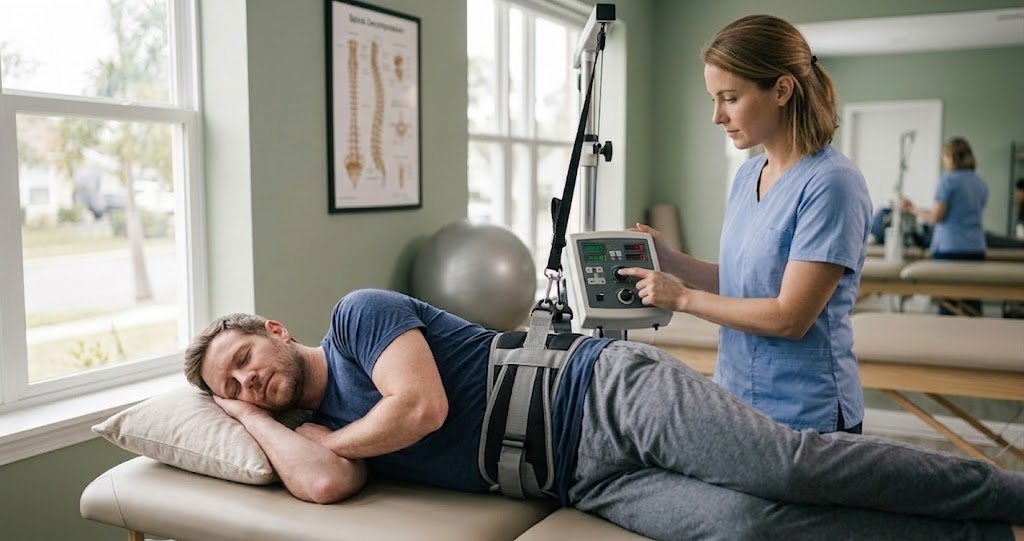
My Back Feels Better From Adjustments, But My Leg Pain Isn't Gone — Why Would I Need Decompression?
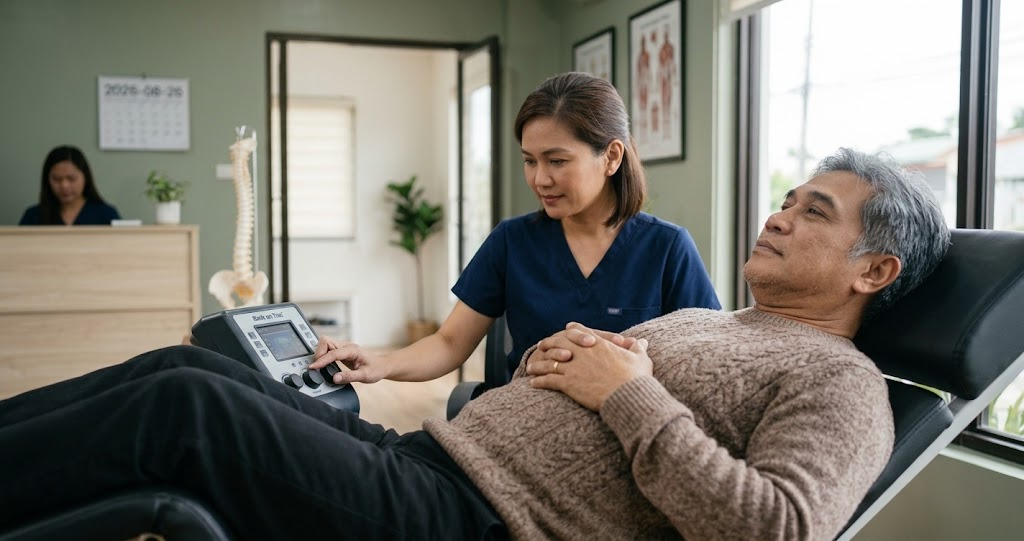
The adjustments are working — your back genuinely feels better. So why is the leg pain, the part that actually bothers you most, still there? That gap between "better" and "actually resolved" is confusing, and it's common enough that Dr. Betty explains it the same way to a lot of patients.
An adjustment works on joint motion and alignment. If the main driver of your leg pain is pressure on a disc or nerve root, an adjustment alone can ease some symptoms without fully addressing that underlying pressure — and that's usually why a patient tells Dr. Betty their back feels better but the leg pain is still there. That's not a treatment failure. It reflects what each tool is actually built to do. A 2019 systematic review of spinal manipulation's effect on lower-limb nerve-related findings found the evidence for a specific, reliable effect on that pathway is genuinely limited (Maxwell, Lauchlan & Dall, 2019) — which lines up with the pattern many patients describe: real relief in the back, without a matching change in the leg.
Why Would I Need Decompression If I'm Already Getting Regular Adjustments?
Because the two tools address different things. An adjustment works on joint motion and alignment. If the main driver of someone's leg pain is pressure on a disc or nerve root, an adjustment alone can ease some symptoms without fully addressing that underlying pressure, and that's usually why a patient tells Dr. Betty their back feels better but the leg pain is still there.
An adjustment works on joint motion and alignment. If the main driver of someone's leg pain is pressure on a disc or nerve root, an adjustment alone can ease some symptoms without fully addressing that underlying pressure. That's usually why a patient tells me their back feels better but the leg pain is still there.
Why Might Routine Adjustments Help Some Patients but Not Fully Address Disc-Related Leg Symptoms?
Adjustments primarily address joint motion and alignment. If the main driver of leg pain is pressure on a disc or nerve root, adjustment alone may ease some symptoms without addressing that underlying pressure — that's often where decompression enters the conversation. Research specifically looking at spinal manipulation's effect on lower-limb neurodynamic findings found the evidence for a reliable, specific effect on that pathway remains limited, even though manipulation is well established for joint mobility and general pain modulation (Maxwell, Lauchlan & Dall, 2019). That's not a criticism of adjustment — it's context for why a second, differently targeted tool sometimes matters.
What Does Back on Trac Decompression Actually Address That Adjustment Doesn't?
On the Back on Trac system, decompression is a tool aimed specifically at reducing pressure on the disc and nerve — a mechanically different target than joint motion. Direct measurements of pressure inside the disc during decompression have shown it can drive intradiscal pressure into negative territory, well below normal resting levels, in a way that joint-focused techniques are not designed to do (Ramos & Martin, 1994). That's the specific gap decompression is built to close.
Does Research Support Decompression for Disc-Related Pressure?
There's real evidence specifically on this point. A 2022 randomized, sham-controlled trial found patients receiving non-surgical spinal decompression showed a significantly greater reduction in herniated disc volume on follow-up MRI than a sham comparison group — 27.6 percent versus 7.1 percent — along with better pain and disability outcomes (Choi et al., 2022). That's outcome evidence tied to the pressure-related mechanism decompression is designed around, not just a plausible-sounding theory.
When Does Dr. Betty Consider Discussing Back on Trac or Cervi-Trac Decompression?
When exam findings and symptom patterns point to disc-related pressure as a significant factor, and a patient hasn't gotten full relief from adjustment alone, decompression becomes part of the conversation as a complementary option. It's brought up when the exam findings and symptom pattern point to disc-related pressure as a real factor — not offered as a routine upgrade for every patient getting adjustments.
How Does Dr. Betty Keep Decompression Positioned as Part of a Plan, Not a Standalone Cure?
She's careful not to present it as a cure-all. It's one tool that addresses pressure specifically, paired with the rest of the exam findings and often combined with chiropractic adjustment — not offered as a guaranteed fix on its own. That combination matters: decompression addresses pressure, adjustment addresses joint motion, and most patients whose exam points toward disc-related pressure benefit from both working together, not one replacing the other.
Which Symptoms Mean This Needs Immediate Care, Not a Decompression Conversation?
Seek immediate medical evaluation if you have:
- Loss of bladder or bowel control
- Numbness in the groin, inner thighs, or saddle area
- Rapidly worsening leg weakness
- A foot that suddenly cannot lift, so it drags or slaps the floor
Those symptoms call for immediate medical evaluation, not a scheduled chiropractic visit or a decompression conversation. Go to an urgent care or emergency room, or call 911 if symptoms are severe.
Short of those, persistent leg pain despite improving back pain is a reasonable, common reason to revisit your plan — not an emergency. A practical first step: take the OKC Sciatica Check at OKCSciaticaCheck.com before your next visit, so the conversation about what's next starts with a clear picture of your pattern.
How Is 'One Tool in a Larger Plan' Different From 'A Cure-All'?
| Positioning Decompression as a Cure-All | Decompression as One Part of a Plan |
|---|---|
| Offered to every patient regardless of exam findings | Brought up when exam findings point to disc-related pressure specifically |
| Presented as a guaranteed fix for leg pain | Presented as one tool addressing pressure, paired with exam findings |
| Positioned as a replacement for adjustment | Often combined with adjustment, not offered instead of it |
| No explanation of what it mechanically addresses | Explained as targeting pressure specifically, distinct from joint motion |
| Success measured by selling the tool | Success measured by whether findings support using it for this patient |
Both descriptions mention the same equipment. Only one describes how it's actually used here.
Who Should I Call in OKC to Discuss Whether Decompression Fits My Case?
Your back feels better from adjustments, but leg pain persists. That's exactly the pattern worth a follow-up exam to check whether disc-related pressure is a factor.
You're not sure whether decompression or continued adjustment is the right next step. That's a fair question for an exam to answer, not something to guess at.
You want to understand what Back on Trac or Cervi-Trac actually does before trying it. Ask directly — it's explained as a specific tool for pressure, not a mystery machine.
Any red-flag symptom from the list above. Urgent care or the ER — not a wait-and-see decision, and not something a decompression conversation should address.
Wherever this conversation goes, if your case needs imaging, medical management, or a surgical opinion, Dr. Betty refers out and shares what she found, so you are not starting over with the next provider.
Take the Next Steps at OKCSciaticaCheck.com
Improvement that stops short of the symptom you actually came in for is worth a real conversation, not quiet frustration. There's a specific, mechanical reason your leg pain might need a different tool than your back pain did — and a specific way to find out if that's true for you.
References
- Maxwell, C. M., Lauchlan, D. T., & Dall, P. M. (2019). The effects of spinal manipulative therapy on lower limb neurodynamic test outcomes in adults: a systematic review. Journal of Manual & Manipulative Therapy, 28(1), 1–13. https://pmc.ncbi.nlm.nih.gov/articles/PMC7006656/
- Ramos, G., & Martin, W. (1994). Effects of vertebral axial decompression on intradiscal pressure. Journal of Neurosurgery, 81(3), 350–353. https://thejns.org/view/journals/j-neurosurg/81/3/article-p350.xml
- Choi, E., Gil, H. Y., Ju, J., Han, W. K., Nahm, F. S., & Lee, P.-B. (2022). Effect of nonsurgical spinal decompression on intensity of pain and herniated disc volume in subacute lumbar herniated disc. International Journal of Clinical Practice, 2022, 6343837. https://www.ncbi.nlm.nih.gov/pmc/articles/PMC9553669/
Frequently Asked Questions
Why does my back feel better from adjustments while my leg pain stays the same?
Because adjustments primarily address joint motion and alignment, while leg pain is often driven by pressure on a disc or nerve root — a different mechanism. Research on spinal manipulation's effect on lower-limb nerve-related findings shows the evidence for a specific effect there is limited (Maxwell, Lauchlan & Dall, 2019), which helps explain the pattern.
Is Back on Trac decompression a replacement for chiropractic adjustments?
Not typically. Decompression is often combined with chiropractic adjustment, not offered instead of it — each addresses a different part of the picture, and most care plans use them together when exam findings support it.
Does research actually support decompression working on disc pressure?
Yes, on the specific mechanism it targets. Direct pressure measurements show decompression can create negative pressure inside the disc (Ramos & Martin, 1994), and a randomized, sham-controlled trial found significantly greater reduction in herniated disc volume with decompression than sham treatment (Choi et al., 2022).
Will decompression definitely fix my leg pain if adjustments haven't?
No guarantee can honestly be made either way. Decompression is one tool that addresses pressure specifically, paired with the rest of the exam findings — not offered as a guaranteed fix on its own. It's brought up when findings point to disc-related pressure as a real factor.
What symptoms mean I shouldn't wait to discuss decompression and need care right away?
Loss of bladder or bowel control, numbness in the groin or saddle area, rapidly worsening leg weakness, or a foot that suddenly can't lift. Those call for immediate medical evaluation, not a scheduled visit.
This article is for general education only and is not a diagnosis, medical advice, or a treatment recommendation. It does not create a doctor-patient relationship. Symptoms cannot be diagnosed from an article. If you have severe or worsening symptoms — especially loss of bladder or bowel control, numbness in the groin or inner thighs, or progressive leg weakness — seek emergency care right away.
Ready for a Reasonable First Step?
Use the free, non-diagnostic Next-Step Checker, or call Precision Care Chiropractic in Oklahoma City to ask about an in-person evaluation.