Physical Therapy Made My Leg Pain Worse — Why Did That Happen, and How Is Decompression Different?
You did what you were told. You stretched, you strengthened, you showed up to every session — and your leg pain got worse, not better. That's confusing, and it can feel like either the therapy failed or you did something wrong. Usually, neither is true.
Patients often say certain stretches or strengthening exercises made the shooting pain worse instead of better, especially early on, before the irritation had calmed down. When a nerve is significantly irritated, movement and loading can actually increase pressure on it before the tissue is ready to handle that stress. It's not that exercise is wrong, it's a timing problem. This isn't just a personal observation — "irritability" is a formal, well-established clinical reasoning concept in rehabilitation, describing how easily a condition is provoked and how long it takes to settle down, and it's specifically used to decide how much movement and load a tissue can tolerate at a given point in recovery (Petersen, Thurmond & Jensen, 2021). Getting that timing wrong is a common, well-recognized reason exercise-based care can backfire early on.
Why Did Physical Therapy or Stretching Make My Leg Pain Worse Instead of Better?
When a nerve is significantly irritated, movement and loading can increase pressure on it before the tissue is ready for that stress. It's not that exercise is wrong — timing and irritability level matter. Asking a highly irritable nerve to do strengthening work too early can flare things up rather than calm them down, even when the exercises themselves are entirely appropriate ones.
When a nerve is significantly irritated, movement and loading can actually increase pressure on it before the tissue is ready to handle that stress. It's not that exercise is wrong, it's a timing problem.
What Do Other Patients Say About PT or Stretching Flaring Up Their Symptoms?
Patients often describe certain stretches or strengthening exercises making the shooting pain worse instead of better, especially early on, before the irritation had calmed down. That pattern — worse before better, specifically with active loading — is common enough that Dr. Betty hears a version of it regularly. It's not a sign the patient did anything wrong.
What Is "Nerve Irritability," and Why Does It Matter for Timing?
Irritability is a formal clinical reasoning construct, judged by how vigorously a symptom is provoked, how severe the reaction is, and how long it takes to settle back down once aggravated (Petersen, Thurmond & Jensen, 2021). It's part of a broader clinical reasoning framework clinicians across professions use to decide how much movement and loading a tissue can tolerate at a given visit — not a vague impression, but a structured judgment made from how the patient responds to specific positions and movements during the exam. When a nerve scores as highly irritable, the appropriate response is to reduce load first, not push through it.
How Is Decompression Different From Stretching or Strengthening Exercise?
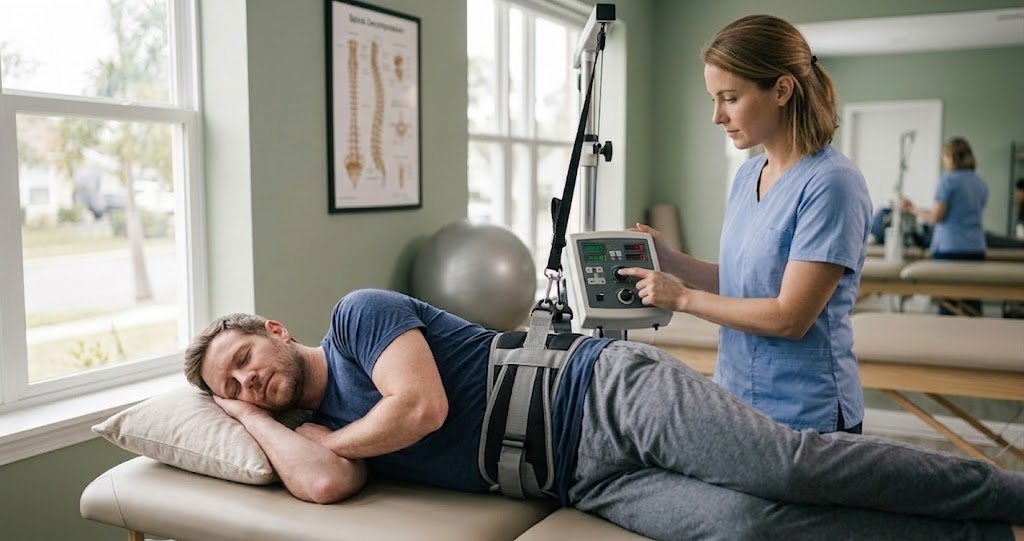
Decompression gently creates space and reduces pressure on the disc and nerve, which can help calm things down — a fundamentally different mechanism than active stretching or strengthening. Direct measurements of pressure inside the disc during decompression have shown it can drive intradiscal pressure into negative territory, well below normal resting pressure, in a way that conventional stretching or manual traction does not achieve (Ramos & Martin, 1994). A 2022 randomized, sham-controlled trial in the International Journal of Clinical Practice found that patients receiving non-surgical spinal decompression showed a significantly greater reduction in herniated disc volume on follow-up MRI — 27.6 percent, versus 7.1 percent in the sham group — along with better pain and disability outcomes (Choi et al., 2022). Decompression unloads; exercise loads. Both have a place, but not usually at the same time.
How Does Dr. Betty Decide What Comes First — Decompression, Adjustment, or Rehab?
She looks at how irritable the nerve seems, how the patient responds to different positions, and what the exam shows. If things are still hot and reactive, she leans toward unloading first — decompression, which gently reduces pressure on the disc and nerve to calm the area down. Once that irritability has settled, stabilization and strengthening can come in and actually stick, rather than reigniting the same flare-up. If a patient isn't responding the way she'd expect, or the exam raises concerns beyond what conservative care addresses, referral comes first, before either of the other two.
How Does Dr. Betty Explain the Difference Between Decompression, Adjustment, and Rehabilitation?
Decompression gently creates space and reduces pressure on the disc and nerve, which can help calm things down. Adjustment addresses joint motion and alignment. Rehabilitation builds strength and stability once the area is ready for load. Often, it's a sequence — calm it down first, then build it back up — rather than one tool doing everything. None of the three is inherently better than the others; they answer different questions at different points in recovery.
Which Symptoms Mean This Needs Immediate Care, Not a Modified Exercise Plan?
Seek immediate medical evaluation if you have:
- Loss of bladder or bowel control
- Numbness in the groin, inner thighs, or saddle area
- Rapidly worsening leg weakness
- A foot that suddenly cannot lift, so it drags or slaps the floor
Those symptoms call for immediate medical evaluation, not a scheduled chiropractic visit or a modified therapy plan. Go to an urgent care or emergency room, or call 911 if symptoms are severe.
A flare-up from stretching or exercise, however uncomfortable, is different from these signs — but it's still worth a fresh evaluation rather than pushing through the same program that triggered it. A practical first step: take the OKC Sciatica Check at OKCSciaticaCheck.com before your visit — it takes a few minutes and helps Dr. Betty's team understand your pattern going in.
How Is 'Calm It Down First, Then Build It Back Up' Different From Jumping Straight to Strengthening?
| Jumping Straight to Strengthening | Calm It Down First, Then Build It Back Up |
|---|---|
| Same exercise plan regardless of how irritable the nerve is | Load matched to irritability, judged by exam and response |
| A flare-up treated as a sign the patient isn't trying hard enough | A flare-up treated as useful information about timing |
| One tool (exercise) expected to do everything | Decompression, adjustment, and rehab sequenced for different jobs |
| Pushing through pain to "build tolerance" | Unloading first when the nerve is still reactive |
| No reassessment if things get worse | Course changed if the patient isn't responding as expected |
Both approaches are trying to get you stronger. Only one is paying attention to whether now is actually the right time for that.
Who Should I Call in OKC After a Physical Therapy Flare-Up?
Stretching or strengthening made your leg pain worse. That's common and worth a fresh evaluation — bring details on what specifically flared it up.
You're not sure whether to keep pushing through your current program. Don't assume more effort is the answer; an exam can judge whether the nerve is still too irritable for loading.
You want to understand whether decompression fits your case. That depends on exam findings, not a blanket preference for one tool over another.
Any red-flag symptom from the list above. Urgent care or the ER — not a wait-and-see decision, and not something a modified exercise plan should address.
Wherever you start, if your case needs imaging, medical management, or a surgical opinion, Dr. Betty refers out and shares what she found, so you are not starting over with the next provider.
Take the Next Steps at OKCSciaticaCheck.com
A flare-up isn't proof that nothing will work — it's information about timing that a program moved a little faster than your nerve was ready for. Calming things down first isn't giving up on getting stronger. It's the step that makes getting stronger actually possible.
References
- Petersen, E. J., Thurmond, S. M., & Jensen, G. M. (2021). Severity, irritability, nature, stage, and stability (SINSS): a clinical perspective. Journal of Manual & Manipulative Therapy, 29(5), 297–309.
- Ramos, G., & Martin, W. (1994). Effects of vertebral axial decompression on intradiscal pressure. Journal of Neurosurgery, 81(3), 350–353. https://thejns.org/view/journals/j-neurosurg/81/3/article-p350.xml
- Choi, E., Gil, H. Y., Ju, J., Han, W. K., Nahm, F. S., & Lee, P.-B. (2022). Effect of nonsurgical spinal decompression on intensity of pain and herniated disc volume in subacute lumbar herniated disc. International Journal of Clinical Practice, 2022, 6343837. https://www.ncbi.nlm.nih.gov/pmc/articles/PMC9553669/
Frequently Asked Questions
Does a flare-up from physical therapy mean the diagnosis was wrong?
Not necessarily. Patients often say certain stretches or strengthening exercises made shooting pain worse instead of better, especially early on, before the irritation had calmed down. It's usually a timing issue — the exercise itself may be entirely appropriate, just introduced before the nerve was ready for that load.
Is decompression just a gentler version of stretching?
No — the mechanism is different. Direct measurements show decompression can create negative pressure inside the disc, well below normal resting pressure, which stretching alone does not achieve (Ramos & Martin, 1994). A randomized, sham-controlled trial found meaningfully greater reduction in herniated disc volume with decompression than with a sham comparison (Choi et al., 2022).
How does Dr. Betty know when a nerve is too irritable for exercise?
Through a structured clinical judgment — how vigorously symptoms are provoked, how severe the reaction is, and how long it takes to settle once aggravated. This "irritability" assessment is a formal part of clinical reasoning in rehabilitation, not a guess (Petersen, Thurmond & Jensen, 2021).
Should I stop all exercise if stretching made my pain worse?
Not necessarily stop entirely, but the current approach likely needs reassessment. An evaluation can determine whether unloading first, through decompression or a modified approach, makes more sense before resuming strengthening work.
What symptoms mean a flare-up needs immediate care rather than a modified plan?
Loss of bladder or bowel control, numbness in the groin or saddle area, rapidly worsening leg weakness, or a foot that suddenly can't lift. Those call for immediate medical evaluation, not a scheduled visit or exercise adjustment.
This article is for general education only and is not a diagnosis, medical advice, or a treatment recommendation. It does not create a doctor-patient relationship. Symptoms cannot be diagnosed from an article. If you have severe or worsening symptoms — especially loss of bladder or bowel control, numbness in the groin or inner thighs, or progressive leg weakness — seek emergency care right away.
Ready for a Reasonable First Step?
Use the free, non-diagnostic Next-Step Checker, or call Precision Care Chiropractic in Oklahoma City to ask about an in-person evaluation.