Why Does Coughing or Sneezing Send an Electric Shock Down My Leg?

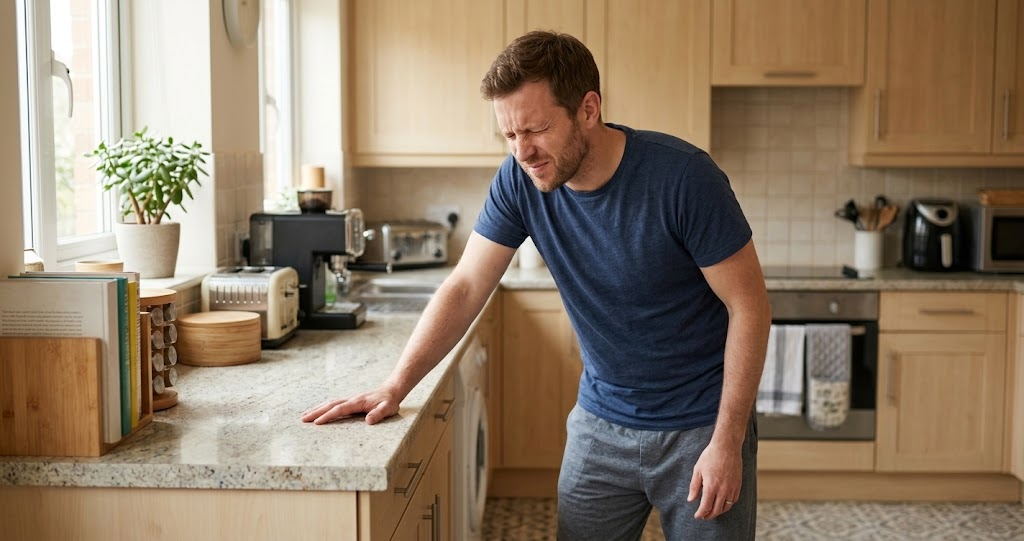
You feel the sneeze coming, and your first thought is your leg. Then it hits: a sharp, electric jolt from your buttock down your leg, gone almost as fast as it arrived, leaving you braced against the counter and wondering what it means.
A cough or sneeze briefly raises pressure inside your body, and a nerve root that is already irritated can react to that sudden change with a sharp, shooting pain down the leg. That pattern is recognized: a Mayo Clinic Health System neurosurgeon notes that the pain of a compressed nerve root can feel like a jolt or electric shock and can be worse when you cough or sneeze (Schiefer, 2021). What it cannot do on its own is tell anyone what is causing the irritation or how serious it is, which is where an examination comes in.
Why Does Coughing or Sneezing Send an Electric Shock Down My Leg?
Because a cough or sneeze is a sudden physical effort, and an irritated nerve root reacts to it. The pressure change reaches the area around the nerve roots in your spine, and if one of them is already sensitive, the result can be a sharp jolt that travels into the buttock and down the leg. The shock is the nerve reacting to the pressure change, and it is information worth reporting.
When you cough or sneeze, your muscles contract suddenly and pressure increases inside your body, including around the nerve roots in your spine. If a nerve root in your lower back is already irritated, that sudden pressure change can trigger a sharp, shooting pain into your buttock and down your leg. That electric shock feeling can happen with sciatica, including when a disc problem is involved. But this symptom alone does not prove that you have a herniated disc or tell us how severe the problem is.
What Is Happening Inside My Body When I Cough or Sneeze?
Both are forceful, sudden efforts. The muscles contract and pressure rises in the chest and abdomen, the same kind of pressure change produced by the Valsalva maneuver, which is bearing down against a closed airway (Srivastav, Jamil & Zeltser, 2022). Dr. Betty's explanation is that this pressure increase extends to the area around the nerve roots in your spine. A healthy nerve root tolerates it without complaint. A root that is already irritated may not.
Does an Electric Shock Down My Leg Mean I Have a Herniated Disc?
It can fit one, but it does not prove one. In Dr. Betty's words, “But this symptom alone does not prove that you have a herniated disc or tell us how severe the problem is.”
The research agrees that it is a clue, not a verdict. In 395 adults with severe sciatica of 6 to 12 weeks' duration, worsening of leg pain during coughing, sneezing, or straining had significant diagnostic value for the presence of nerve root compression and disc herniation on MRI (Verwoerd et al., 2016). Useful to ask about, then, but not proof by itself.
Images carry the same caution. A meta-analysis reviewed in a 2019 BMJ article reported disc protrusion on MRI in 57% of people with symptoms and 34% of people without, and the authors describe disc herniations as common age-related findings that matter mainly when they are accompanied by sciatica (Jensen et al., 2019). A symptom and an image both need to be read in the context of an examination.
Why Does the Shock Travel Into My Buttock and Down My Leg?
Because that is where the nerve goes. The sciatic nerve forms from nerve roots in the lower spine and runs through the buttock and down the leg, so irritation near the spine can be felt along that whole route. Pain from an irritated nerve root is often sharp and shooting, and the Mayo neurosurgeon adds that it can range from a mild ache to a burning sensation or a jolt (Schiefer, 2021). Where yours travels, and how far, is one of the first things Dr. Betty wants to know.
What Does Dr. Betty Want to Know About My Cough or Sneeze Pain?
Three things:
- Where the pain travels
- When it started
- Whether you also have numbness or weakness
Then she examines you and checks your nerve function before recommending care. That order matters. The jolt tells her where to look, and the examination tells her what is actually going on.
Which Symptoms Can't Wait, Even if It Started With a Sneeze?
Get medical care now if you have:
- New or worsening leg weakness, including a foot that starts dragging or trouble lifting the front of your foot
- New difficulty urinating, loss of bowel or bladder control, or numbness around the groin, genitals, or inner thighs (the saddle area)
- Severe or worsening weakness or numbness in both legs
- Sudden major loss of feeling in your leg
- Back pain with fever, chills, or feeling generally unwell
- Unexplained weight loss alongside persistent back pain
Those symptoms call for immediate medical evaluation, not a scheduled chiropractic visit. Go to an urgent care or emergency room, or call 911 if symptoms are severe.
If you develop new or worsening leg weakness, seek urgent medical evaluation. New bladder or bowel problems, or numbness around your groin, require emergency evaluation. Short of that, a cough-or-sneeze jolt is a schedule-an-evaluation situation. A practical first step is to take the OKC Sciatica Check at OKCSciaticaCheck.com, which helps you organize what you are feeling before your visit.
How Is Assuming a Herniated Disc Different From Being Examined?
| Assuming a Herniated Disc | Dr. Betty's Evaluation-First Approach |
|---|---|
| Deciding the shock means a herniated disc | Treating it as a clue that fits a nerve root problem, without treating it as proof |
| Ignoring a jolt that lasts only a second | Reporting it, because where it travels and when it started are exam details |
| Reading how sharp the pain is as how serious the problem is | Recognizing that the symptom alone cannot show severity |
| Judging by a symptom or an image alone | Examining you and checking nerve function |
| Waiting for weakness before taking it seriously | Knowing that new or worsening weakness needs urgent medical evaluation |
Both approaches take the shock seriously. Only one lets the examination decide what it means.
What Should I Do Next if Coughing or Sneezing Sends a Shock Down My Leg?
The next time it happens, notice where the pain travels and how far it goes, and check yourself for numbness or weakness. Check the red-flag list above. You do not need to know whether it is a disc, a nerve root, or something else before you call; that is what the evaluation is for. If the shocks are becoming more frequent, or the leg pain is interfering with your sleep, walking, work, or daily activities, that is reason enough to schedule. You can call or text the office, or book online, and the team is glad to answer questions before you schedule anything.
Take the Next Steps at OKCSciaticaCheck.com
A shock that lasts a second is easy to shrug off, and it is exactly the kind of detail that helps an examination. Telling someone where it travels and when it started takes a minute. Telling no one can mean months of wondering what it means.
- Precision Care Chiropractic — 5850 W Wilshire Blvd, Oklahoma City, OK 73132
- Call or text: (405) 803-8770
- Book online: precisioncarechiropractic.com/new-patient-form
- Take the next steps at OKCSciaticaCheck.com.
References
- Verwoerd, A. J. H., Mens, J., El Barzouhi, A., Peul, W. C., Koes, B. W., & Verhagen, A. P. (2016). A diagnostic study in patients with sciatica establishing the importance of localization of worsening of pain during coughing, sneezing and straining to assess nerve root compression on MRI. European Spine Journal, 25(5), 1389–1392. https://doi.org/10.1007/s00586-016-4393-8
- Srivastav, S., Jamil, R. T., & Zeltser, R. Valsalva Maneuver. StatPearls [Internet]. National Center for Biotechnology Information, National Institutes of Health. Updated 2022. https://www.ncbi.nlm.nih.gov/books/NBK537248/
- Schiefer, T. K. (2021, July 9). Sciatica and radiculopathy: Peculiar names for shooting back, leg pain. Speaking of Health, Mayo Clinic Health System. https://www.mayoclinichealthsystem.org/hometown-health/speaking-of-health/sciatica-and-radiculopathy-peculiar-names
- Jensen, R. K., Kongsted, A., Kjaer, P., & Koes, B. (2019). Diagnosis and treatment of sciatica. BMJ, 367, l6273. https://doi.org/10.1136/bmj.l6273
Frequently Asked Questions
Why does sneezing or coughing send an electric shock down my leg?
A cough or sneeze raises pressure inside your body, including around the nerve roots in your spine. If a nerve root in the lower back is already irritated, that sudden change can trigger a sharp, shooting pain into the buttock and down the leg.
Does an electric shock down my leg mean I have a herniated disc?
Not necessarily. It can happen with sciatica, including when a disc problem is involved, but the symptom by itself cannot confirm a herniated disc or show how severe the problem is. In patients with severe sciatica, worsening of leg pain with coughing, sneezing, or straining had significant diagnostic value for nerve root compression on MRI (Verwoerd et al., 2016), which makes it a clue rather than proof.
Can a disc problem show up on an MRI even if I have no symptoms?
Yes. A meta-analysis reviewed in a 2019 BMJ article reported disc protrusion in 57% of symptomatic people and 34% of asymptomatic people, which is why imaging findings are read alongside symptoms and an examination (Jensen et al., 2019).
Isn't a one-second shock too minor to bring up?
No. Where the pain travels, when it started, and whether you also have numbness or weakness are exactly the details an examination builds on. Take the OKC Sciatica Check at OKCSciaticaCheck.com to organize what you have noticed before your visit; the examination is what turns the clue into an answer.
What does Dr. Betty ask about cough and sneeze pain?
Where the pain travels, when it started, and whether you also have numbness or weakness. Then she examines you and checks your nerve function before recommending care.
Which symptoms mean a sneeze-triggered jolt can't wait for a scheduled appointment?
New or worsening leg weakness needs urgent medical evaluation. New bladder or bowel problems, or numbness around the groin, require emergency evaluation. Back pain with fever, chills, or feeling generally unwell needs urgent medical assessment.
This article is for educational purposes only and is not medical advice, diagnosis, or treatment. It does not establish a doctor-patient relationship and does not guarantee any outcome or result. Individual results vary. Only an in-person evaluation by a qualified provider can determine what may be contributing to your symptoms and what care, if any, is appropriate for you. If you are experiencing any of the red-flag symptoms described in this article, seek immediate medical evaluation.
Ready for a Reasonable First Step?
Use the free, non-diagnostic Next-Step Checker, or call Precision Care Chiropractic in Oklahoma City to ask about an in-person evaluation.
Keep Reading
Sneezing Feels Like an Explosion in Your Lower Back That Radiates Down Your Leg: What That Jolt May Mean

Why Does Sciatica Pain Travel Below the Knee and Into Your Foot or Toes?

Is Pain Shooting From Your Lower Back or Buttock Down Your Leg Actually Sciatica?