Sneezing Feels Like an Explosion in Your Lower Back That Radiates Down Your Leg: What That Jolt May Mean
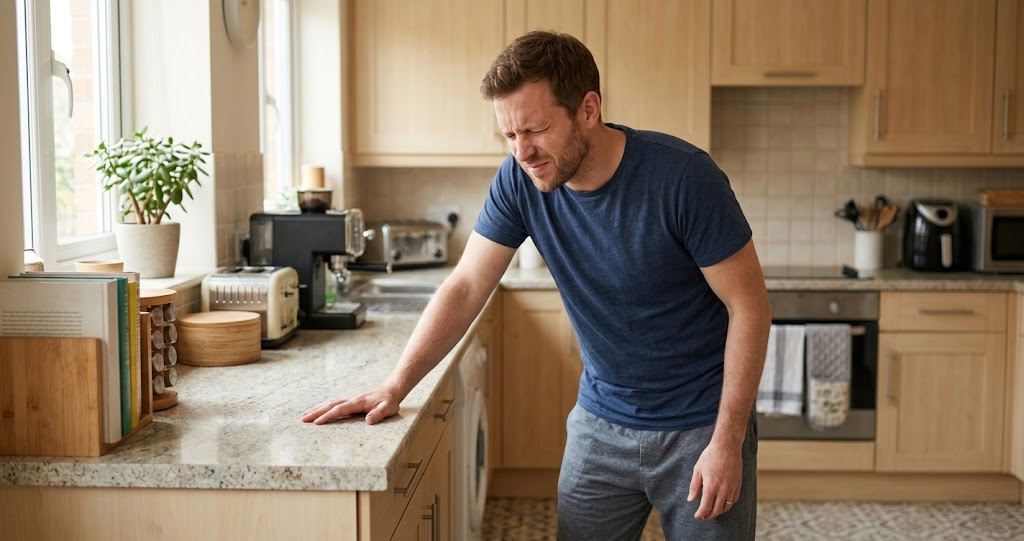
One sneeze, and suddenly you're gripping the counter. It wasn't the sneeze itself — it was what shot down your leg half a second later, sharp enough to make you wonder what just happened to your back.
A sneeze or cough that sends pain shooting down the leg may suggest a pressure-sensitive structure in the low back reacting to a sudden spike in pressure — most often a disc that's already irritated. It is not, on its own, proof of a herniated disc. Where the pain shows up actually matters a great deal here: a 2016 diagnostic study in the European Spine Journal followed 395 patients with sciatica and found that pain worsening specifically in the leg during coughing, sneezing, or straining — as opposed to worsening only in the back — carried real diagnostic value for nerve root compression and disc herniation on MRI, more than doubling the odds (Verwoerd et al., 2016). That's a meaningful clue. Only an exam, and imaging if needed, can tell what's actually going on.
What Clinical Possibilities Does Dr. Betty Consider When Sneezing Sends Pain Into the Leg?
When sneezing or coughing shoots pain into the leg, Dr. Betty thinks about pressure-sensitive structures in the low back — most often a disc that's irritated and reacting to the sudden spike in pressure a sneeze or cough creates. It's a useful clue, not a diagnosis on its own. The location of the pain matters: pain that stays in the back points toward one set of possibilities, while pain that radiates into the leg points toward nerve root involvement specifically.
When sneezing or coughing shoots pain into the leg, I think about pressure-sensitive structures in the low back, most often a disc that's irritated and reacting to the sudden spike in pressure a sneeze or cough creates. It's a useful clue, not a diagnosis on its own.
Does Pain Only in the Back Mean Something Different Than Pain That Radiates Into the Leg?
Yes — the distinction is one of the more diagnostically useful details a patient can report. In the Verwoerd et al. (2016) study of 395 sciatica patients, worsening of leg pain specifically during coughing, sneezing, or straining showed a diagnostic odds ratio of 2.28 for nerve root compression and 2.50 for a herniated disc confirmed on MRI — meaningfully higher than reports of back pain alone worsening with the same triggers. That doesn't mean back-only pain is unimportant. It means leg pain specifically is the detail worth paying closest attention to and reporting clearly during an evaluation.
Why Do Sneezing and Coughing Spike Pressure on the Spine in the First Place?
A sneeze is a small, involuntary version of the Valsalva maneuver — you inhale sharply, the airway briefly closes, and your abdominal and trunk muscles contract hard all at once, spiking pressure inside your chest and abdomen (Srivastav, Jamil & Zeltser, StatPearls, NIH/NCBI). That pressure transmits into the spine. Direct in vivo measurements of pressure inside the lumbar disc during daily activities have confirmed that sudden trunk-loading actions like coughing and sneezing genuinely do raise pressure on the disc in real time, not just in theory (Wilke et al., 1999).
If a disc or nerve nearby is already sensitive, that pressure spike is enough to trigger a jolt of pain. It's a pattern worth paying attention to — but a jolt during a sneeze doesn't, by itself, tell you the size or location of what's irritated. That's what the exam and imaging, if needed, are for.
Which Symptoms Mean This Isn't Just a Sneeze-Related Flare-Up?
Seek immediate medical evaluation if the jolt comes with:
- Loss of bladder or bowel control
- Numbness in the groin, inner thighs, or saddle area
- New or rapidly worsening leg weakness
- A foot that suddenly cannot lift, so it drags or slaps the floor
Those symptoms call for immediate medical evaluation, not a scheduled chiropractic visit. Go to an urgent care or emergency room, or call 911 if symptoms are severe.
Short of those signs, a sneeze-triggered jolt — even a dramatic one — is generally a schedule-an-evaluation situation rather than an emergency.
What Should I Avoid Doing Before I'm Evaluated?
Avoid heavy lifting, deep twisting, and long stretches of sitting until you've been evaluated. If you feel a sneeze or cough coming on, try not to bend forward sharply into it — bracing gently, or turning your head to the side, can soften the jolt. A practical first step in the meantime: take the OKC Sciatica Check at OKCSciaticaCheck.com before your visit — it takes a few minutes and helps Dr. Betty's team understand your pattern before you walk in.
What Happens During an Evaluation at Precision Care Chiropractic?
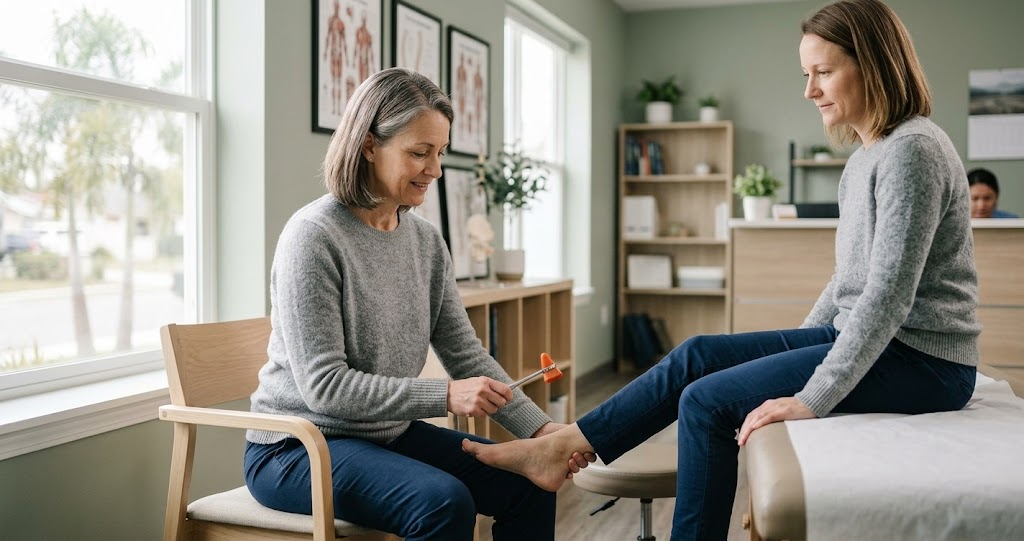
An evaluation starts with listening — when the jolt happens, whether it stays in the back or travels into the leg, and what else has changed. Then comes orthopedic testing, reflex testing at the knee and ankle, strength testing in the leg and foot, sensation testing, and a look at posture and range of motion in the low back and hips. Only after that does Dr. Betty talk with you about what may be contributing and what reasonable next steps look like.
What Should I Bring to My First Visit?
The written report from any MRI or X-ray, the images themselves if you have them, notes on what you've already tried, and a rough timeline — including whether the jolt has happened more than once and whether it's changing. Precision Care has digital X-ray on-site if imaging is clinically indicated early on; MRI is not performed in-office, and patients are referred to imaging centers in the Oklahoma City area if one is needed.
How Is Treating This as a Pattern Worth Evaluating Different From Assuming It's Definitely a Herniated Disc?
| Assuming It's Definitely a Herniated Disc | Dr. Betty's Evaluation-First Approach |
|---|---|
| Treating one dramatic sneeze-jolt as a confirmed diagnosis | Treating it as a useful clue that narrows, but doesn't answer, the question |
| Not tracking whether the pain stays in the back or travels into the leg | Noting the location specifically — it changes the diagnostic picture |
| Avoiding all movement indefinitely out of fear | Avoiding specific triggers (heavy lifting, twisting, long sitting) while getting evaluated promptly |
| Assuming imaging is automatically required | Starting with history and exam; imaging only when it will change the plan |
| Panicking over a single flare-up, or dismissing it entirely | Taking it seriously without alarm — a pattern worth evaluating, not an emergency by default |
Both reactions are understandable in the moment. Only one gives a real exam something specific to work with.
Who Should I Call in OKC About Sneeze-Triggered Back and Leg Pain?
The jolt stays in your back, no leg pain, no red flags. A conservative evaluation is a reasonable starting point.
The jolt clearly radiates into the leg, especially past the knee. That detail carries real diagnostic weight — mention it specifically and prioritize a prompt evaluation.
You already have imaging showing a disc finding. Bring it in — Dr. Betty reviews prior imaging and compares it to your actual symptoms rather than treating the report alone.
Any red-flag symptom from the list above. Urgent care or the ER — not a wait-and-see decision. Take the OKC Sciatica Check at OKCSciaticaCheck.com if you're unsure which category fits; it organizes your pattern, it doesn't diagnose it.
Wherever you start, the goal is the same: getting you to the right hands. If your case needs imaging, medical management, or a surgical opinion, Dr. Betty refers out and shares what she found, so you are not starting over with the next provider.
Take the Next Steps at OKCSciaticaCheck.com
A single sneeze that sends you gripping the counter is memorable precisely because it's sudden — but sudden isn't the same as serious, and vague isn't the same as safe. The pattern you noticed today, reported clearly, is worth more to an evaluation than a year of flinching every time you feel a cough coming on.
References
- Verwoerd, A. J. H., Mens, J., El Barzouhi, A., Peul, W. C., Koes, B. W., & Verhagen, A. P. (2016). A diagnostic study in patients with sciatica establishing the importance of localization of worsening of pain during coughing, sneezing and straining to assess nerve root compression on MRI. European Spine Journal, 25(5), 1389–1392. https://doi.org/10.1007/s00586-016-4393-8
- Wilke, H. J., Neef, P., Caimi, M., Hoogland, T., & Claes, L. E. (1999). New in vivo measurements of pressures in the intervertebral disc in daily life. Spine, 24(8), 755–762. https://pubmed.ncbi.nlm.nih.gov/10222525/
- Srivastav, S., Jamil, R. T., & Zeltser, R. Valsalva Maneuver. StatPearls [Internet]. National Center for Biotechnology Information, National Institutes of Health. Updated May 2, 2022. https://www.ncbi.nlm.nih.gov/books/NBK537248/
Frequently Asked Questions
Does a sneeze that causes leg pain mean I definitely have a herniated disc?
No. It's a useful clue, not a diagnosis on its own. Research does show that leg pain specifically — more than back pain alone — worsening with sneezing, coughing, or straining is meaningfully associated with nerve root compression and disc herniation on MRI (Verwoerd et al., 2016). But confirming that requires a history, exam, and imaging when appropriate, not a single moment.
Why does the location of the pain (back only vs. radiating into the leg) matter so much?
Because the two patterns point toward different possibilities. In a 395-patient study, leg pain worsening during coughing, sneezing, or straining carried significantly higher diagnostic value for nerve root compression than back pain alone did — more than double the odds in that study. Reporting exactly where the pain traveled helps focus the evaluation.
Isn't researching this myself online basically the same as getting evaluated?
It's a fair instinct, but a description — even a well-researched one — can't examine you. The OKC Sciatica Check organizes the same pattern details Dr. Betty would ask about in person, so your evaluation starts with information instead of a blank page. Take the OKC Sciatica Check at OKCSciaticaCheck.com to prepare for a real evaluation, not to replace one.
Should I avoid sneezing or holding it in to protect my back?
Holding in a sneeze isn't recommended and can create its own pressure problems. Instead, avoid heavy lifting, deep twisting, and long stretches of sitting until you've been evaluated, and brace gently or turn your head to the side if you feel a sneeze coming on.
When does a sneeze-triggered jolt become an emergency?
When it comes with loss of bladder or bowel control, numbness in the groin or saddle area, new or rapidly worsening leg weakness, or a foot that suddenly can't lift. Those call for immediate medical evaluation, not a scheduled visit.
This article is for general education only and is not a diagnosis, medical advice, or a treatment recommendation. It does not create a doctor-patient relationship. Symptoms cannot be diagnosed from an article. If you have severe or worsening symptoms — especially loss of bladder or bowel control, numbness in the groin or inner thighs, or progressive leg weakness — seek emergency care right away.
Ready for a Reasonable First Step?
Use the free, non-diagnostic Next-Step Checker, or call Precision Care Chiropractic in Oklahoma City to ask about an in-person evaluation.
Keep Reading
Hot, Shooting Pain From Your Hip Into Your Calf When You Drive: What It May Mean, and Where to Start in OKC
My Foot and Big Toe Keep Falling Asleep When I Sit or Drive: What That Signal May Mean

Which Sciatica Symptoms Mean You Should Skip the Chiropractor and Get Immediate Medical Care?