What Tests Does Dr. Betty Bampoe Perform to Evaluate Possible Sciatic Nerve Compression?
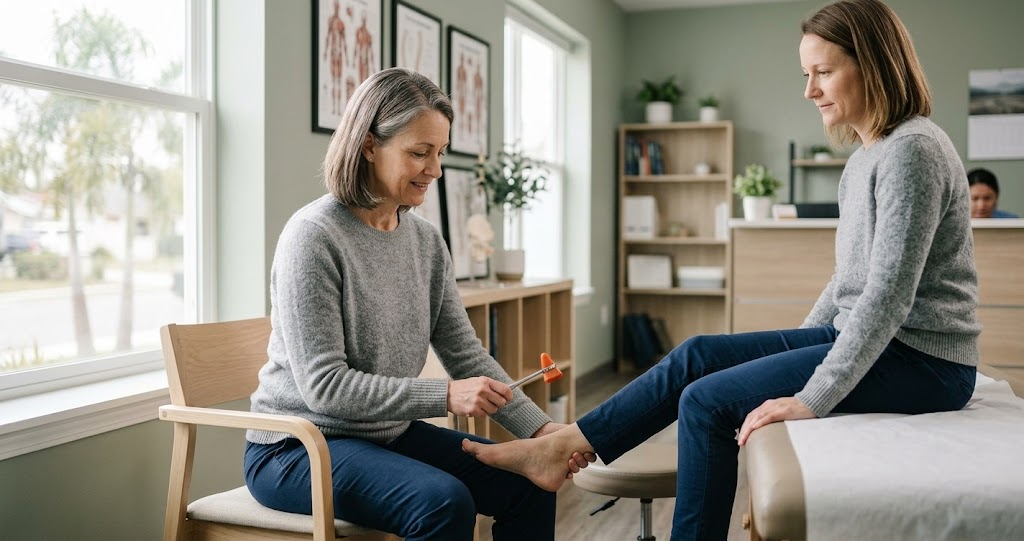
You want to know what you're actually walking into — not a vague reassurance that "we'll take a look," but the real list. Fair. Here it is.
A first evaluation for possible sciatic nerve compression includes orthopedic tests such as straight-leg raise, reflex testing at the knee and ankle, muscle strength testing in the leg and foot, sensation testing, and an assessment of posture and range of motion in the low back and hips. No single one of those tests is decisive on its own — that's not a weakness in the process, it's the reason there are several. A 2010 Cochrane systematic review of physical examination for lumbar radiculopathy found that most individual tests trade off sensitivity for specificity: the straight-leg raise, for example, is good at catching true cases (pooled sensitivity 0.92 in surgical populations) but poor at ruling out other causes on its own (pooled specificity 0.28) (van der Windt et al., 2010). That's exactly why Dr. Betty uses a battery of tests together rather than one shortcut test to decide anything.
What Orthopedic, Neurological, Postural, and Range-of-Motion Checks Are Part of a First Evaluation?
A first evaluation includes orthopedic tests such as straight-leg raise, reflex testing at the knee and ankle, muscle strength testing in the leg and foot, sensation testing, and an assessment of posture and range of motion in the low back and hips. Each test targets something specific: the straight-leg raise checks for nerve root tension, reflex testing checks the integrity of specific nerve levels, strength and sensation testing map which nerve root may be involved, and posture and range-of-motion assessment provides context for how the whole system is moving together.
I walk through each test before I do it. I explain what I'm checking and why, so nothing feels like a surprise. Most are simple movements or light touch; none are meant to hurt, and I'll adjust if something feels uncomfortable.
How Accurate Are These Individual Tests on Their Own?
Individually, imperfect — which is exactly why they're used as a set. Beyond the straight-leg raise numbers above, a 2017 systematic review of clinical neurological exam components found sensory testing carries a sensitivity around 0.61 and specificity around 0.63 against MRI, while reflex testing tends to run the opposite way — lower sensitivity (as low as 0.14 in some studies) but much higher specificity, up to 0.93 in others (Tawa, Rhoda & Diener, 2017). In plain terms: reflex testing is good at confirming a real problem when it's abnormal, but a normal reflex doesn't rule much out; sensory testing catches more cases but flags more false alarms too. Put together, the combination narrows things down in a way no single test can.
How Does Dr. Betty Explain These Tests to a Nervous Patient?
She walks through each test before doing it and explains what she's checking and why, so nothing feels like a surprise. Most are simple movements or light touch; none are meant to hurt, and she'll adjust if something feels uncomfortable. That structure matters as much as the tests themselves — a patient who understands why a test is happening tends to relax into it, which actually makes the findings more reliable.
Why Does Listening Come Before Any Hands-On Testing?
Because history-taking genuinely narrows the picture before a single test is performed. Classic diagnostic research on sciatica evaluation found that a careful history — how the pain started, what makes it better or worse, and how it's affecting daily life — meaningfully contributes to the overall diagnostic picture, working alongside the physical exam rather than as a formality before it (Vroomen, de Krom & Knottnerus, 1999). Dr. Betty starts by listening for exactly this reason: it's not small talk, it's data.
What Should I Bring if I Already Have MRI, X-Ray, or Prior Treatment Records?
Bring the written report and, if possible, the images themselves on a CD or USB, along with notes on what treatments you've already tried and how your body responded. That history helps Dr. Betty build on what's already known instead of starting from zero — prior imaging and treatment response are genuinely useful context, not just paperwork.
Which Symptoms Should Be Reported Immediately, Not Saved for the Exam?
Seek immediate medical evaluation if you have:
- Loss of bladder or bowel control
- Numbness in the groin, inner thighs, or saddle area
- Rapidly worsening leg weakness
- A foot that suddenly cannot lift, so it drags or slaps the floor
Those symptoms call for immediate medical evaluation, not a scheduled chiropractic visit. Go to an urgent care or emergency room, or call 911 if symptoms are severe.
A practical first step for everything short of that: take the OKC Sciatica Check at OKCSciaticaCheck.com before your visit — it takes a few minutes and helps Dr. Betty's team understand your pattern before you walk in.
What Happens After the Exam Is Complete?
Only after Dr. Betty has put your history, the exam findings, and any imaging together does she talk with you about whether a conservative plan makes sense, what it involves, and whether anything points toward a different kind of care or a referral instead. The exam isn't a formality on the way to a predetermined plan — it's what the plan is actually built from.
How Is a Full Battery of Tests Different From Relying on One Test or Symptom Alone?
| Relying on One Test or Symptom Alone | Dr. Betty's Full Battery Approach |
|---|---|
| A single positive test treated as a confirmed diagnosis | Multiple tests interpreted together, since each has different strengths and blind spots |
| A single negative test treated as "nothing's wrong" | A negative test viewed in context, not as a final answer on its own |
| Skipping history-taking to get straight to hands-on testing | History taken first, since it genuinely narrows the diagnostic picture |
| No explanation of what a test is checking for | Each test explained beforehand — what it checks and why |
| Imaging and prior records set aside as "we'll start fresh" | Prior imaging and treatment history reviewed and built upon |
Both approaches produce an opinion. Only one produces an opinion grounded in enough information to actually act on.
Who Should I Call in OKC for a Real Sciatic Nerve Evaluation?
You want to understand your symptoms before committing to anything. Call or text — questions are welcome before you schedule an evaluation.
You already have imaging or a treatment history. Bring it; a full evaluation builds on what's already known rather than starting over.
You're nervous about being examined. Say so — each test gets explained beforehand, and none are meant to hurt.
Any red-flag symptom from the list above. Urgent care or the ER — not a wait-and-see decision. Take the OKC Sciatica Check at OKCSciaticaCheck.com if you're unsure which category fits.
Wherever you start, the goal is the same: getting you to the right hands. If your case needs imaging, medical management, or a surgical opinion, Dr. Betty refers out and shares what she found, so you are not starting over with the next provider.
Take the Next Steps at OKCSciaticaCheck.com
Knowing exactly what an evaluation involves is supposed to make it less intimidating, not more. The tests are specific, explained, and gentle by design — the only thing missing is the actual appointment. The longer that's put off, the longer you're guessing at a pattern a real exam could clarify in one visit.
References
- van der Windt, D. A., Simons, E., Riphagen, I. I., Ammendolia, C., Verhagen, A. P., Laslett, M., et al. (2010). Physical examination for lumbar radiculopathy due to disc herniation in patients with low-back pain. Cochrane Database of Systematic Reviews, Issue 2, Art. No.: CD007431. https://www.cochranelibrary.com/cdsr/doi/10.1002/14651858.CD007431.pub2
- Tawa, N., Rhoda, A., & Diener, I. (2017). Accuracy of clinical neurological examination in diagnosing lumbo-sacral radiculopathy: a systematic literature review. BMC Musculoskeletal Disorders, 18(1), 93. https://www.ncbi.nlm.nih.gov/pmc/articles/PMC5324296/
- Vroomen, P. C., de Krom, M. C., & Knottnerus, J. A. (1999). Diagnostic value of history and physical examination in patients suspected of sciatica due to disc herniation: a systematic review. Journal of Neurology, 246(10), 899–906.
Frequently Asked Questions
What is the straight-leg raise test, and does it hurt?
It's a test where your leg is raised while kept straight, checking whether that motion reproduces your typical leg pain — a sign of possible nerve root tension. It's not meant to hurt, and Dr. Betty explains it before performing it, adjusting if something feels uncomfortable.
If one test comes back negative, does that mean nothing's wrong?
Not necessarily. Research shows most individual exam tests trade off sensitivity and specificity — a negative result on one test doesn't rule out nerve involvement on its own (van der Windt et al., 2010). That's why findings are interpreted together rather than test by test.
Isn't answering questions online basically the same as a real neurological exam?
No — a description can't reproduce a reflex, test strength, or map sensation the way a hands-on exam does. The OKC Sciatica Check organizes your pattern ahead of time; it doesn't replace the exam. Take the OKC Sciatica Check at OKCSciaticaCheck.com to prepare for your visit, not to substitute for it.
Why does Dr. Betty ask so many questions before touching anything?
Because a careful history genuinely narrows the diagnostic picture before any physical test is performed, according to classic diagnostic research on sciatica evaluation (Vroomen et al., 1999). Listening isn't a formality — it's part of the evaluation.
What symptoms should I mention right away instead of waiting for my exam?
Loss of bladder or bowel control, numbness in the groin or saddle area, rapidly worsening leg weakness, or a foot that suddenly can't lift. Those call for immediate medical evaluation, not a scheduled visit.
This article is for general education only and is not a diagnosis, medical advice, or a treatment recommendation. It does not create a doctor-patient relationship. Symptoms cannot be diagnosed from an article. If you have severe or worsening symptoms — especially loss of bladder or bowel control, numbness in the groin or inner thighs, or progressive leg weakness — seek emergency care right away.
Ready for a Reasonable First Step?
Use the free, non-diagnostic Next-Step Checker, or call Precision Care Chiropractic in Oklahoma City to ask about an in-person evaluation.
Keep Reading
Hot, Shooting Pain From Your Hip Into Your Calf When You Drive: What It May Mean, and Where to Start in OKC

Shooting Pain That Travels Past Your Knee Into Your Ankle: Is Chiropractic Care Safe If It's a Disc?

Which Sciatica Symptoms Mean You Should Skip the Chiropractor and Get Immediate Medical Care?