Do You Need an MRI Before a Conservative Clinic in OKC Will See You for Sciatica?

You're stalling on the phone call because you assume the first question will be "do you have your MRI?" It probably won't be. Most people don't need one to get started.
No — most straightforward cases can begin with a conservative evaluation without new imaging. Dr. Betty's starting point is always what the patient brings her and what she finds on exam; if existing records give a clear enough picture and there are no red flags, care can often move forward without ordering anything new. That approach matches national guidance directly: the American College of Physicians advises against routine imaging for low back pain and recommends it be reserved for cases where findings would actually change the treatment plan (Chou, Qaseem, Owens & Shekelle, 2011). I don't order imaging as a routine step. I order it, or refer out for it, when it will change what we do next.
Will I Need an MRI or X-Ray Before I Can Be Evaluated at a Conservative Clinic in OKC?
No, not for most straightforward cases. Precision Care has digital X-ray on-site, so if imaging is needed early in the process, it can often happen the same visit. Advanced imaging like MRI becomes important when red-flag symptoms are present, when pain isn't responding as expected, or when a clearer picture of soft tissue or nerve involvement is needed — not as a default first step for everyone who calls.
I don't order imaging as a routine step. I order it, or refer out for it, when it will change what we do next.
Why Doesn't Dr. Betty Order Imaging as a Routine First Step?
Because the evidence doesn't support it as a default. A 2009 systematic review and meta-analysis in The Lancet found no meaningful difference in outcomes between patients who received routine imaging for low back pain and those who received usual care without it (Chou, Fu, Carrino & Deyo, 2009). The American College of Physicians' subsequent advice was direct: routine imaging for uncomplicated low back pain does not improve patient outcomes and should be reserved for cases with red flags or where it would change management (Chou et al., 2011). Ordering imaging by default isn't more thorough care — it's often just more imaging.
Why Don't MRI Findings Always Match How Someone Actually Feels?
Because imaging findings and how someone actually feels don't always line up — and that's not a rare exception, it's well documented. A systematic review of imaging findings in 3,110 people with no back symptoms at all found disc degeneration in 37 percent of 20-year-olds, rising to 96 percent by age 80, and disc bulges in 30 percent of 20-year-olds, rising to 84 percent by age 80 (Brinjikji et al., 2015). In other words, a disc finding on a scan is common at every age, symptomatic or not. That's exactly why Dr. Betty compares imaging findings against a patient's actual symptoms and exam results rather than treating a report alone as the diagnosis.
Does Dr. Betty Review Outside MRI or X-Ray Reports?
Yes. Bring the written report and, if possible, the images themselves on a CD or USB. She reviews both the radiologist's findings and, when available, the images themselves, and compares them against your actual symptoms and exam findings — because, as the research above shows, the report alone doesn't tell the whole story.
When Does Dr. Betty Believe Imaging Is Actually Needed?
Advanced imaging like MRI becomes important when red-flag symptoms are present, when pain isn't responding as expected, or when a clearer picture of soft tissue or nerve involvement is needed before deciding on a plan. Those are specific triggers, not a routine checkbox — imaging gets ordered, or referred out, when it will change what happens next.
Can Precision Care Perform X-Rays or MRI On-Site?
Precision Care has digital X-ray on-site, so many patients can be imaged the same day if it's clinically indicated. If an MRI is needed, patients are referred out to trusted imaging centers in the Oklahoma City area — MRI is not performed in-office. That's a real practical distinction worth knowing before you call: same-day X-ray is possible here; an MRI, if one is warranted, happens elsewhere.
Which Symptoms Mean Imaging Should Happen Right Away?
Seek immediate medical evaluation (which includes emergency imaging) if you have:
- Loss of bladder or bowel control
- Numbness in the groin, inner thighs, or saddle area
- Rapidly worsening leg weakness
- Severe symptoms following a major fall, crash, or trauma
- Fever or unexplained weight loss with new severe back pain
Those symptoms call for immediate medical evaluation, not a scheduled chiropractic visit. Go to an urgent care or emergency room, or call 911 if symptoms are severe.
A practical first step for everything short of that: take the OKC Sciatica Check at OKCSciaticaCheck.com before your visit — it takes a few minutes and helps Dr. Betty's team understand your pattern, imaging or no imaging, before you walk in.
How Is 'Imaging When It Changes the Plan' Different From Assuming You Need an MRI First?
| Assuming You Need an MRI First | Dr. Betty's Evidence-Based Approach |
|---|---|
| Delaying evaluation for weeks waiting on imaging | Beginning a conservative evaluation the same visit, in most cases |
| Treating any imaging finding as automatically the cause of pain | Comparing findings against actual symptoms and exam results |
| Imaging ordered as a default for every new patient | Imaging ordered only when it will change the treatment plan |
| No practical distinction between X-ray and MRI availability | Same-day digital X-ray on-site; MRI referred out when warranted |
| Assuming more imaging equals more thorough care | Following evidence that routine imaging doesn't improve outcomes |
Both approaches can feel like due diligence. Only one is actually supported by what the research shows about outcomes.
Who Should I Call in OKC to Start a Conservative Evaluation Without Assuming I Need an MRI First?
You don't have any prior imaging. That's fine — most straightforward cases begin with a conservative evaluation without new imaging.
You already have an MRI or X-ray report. Bring it; Dr. Betty reviews it against your current symptoms rather than treating the report alone as the answer.
Same-day imaging matters to you. Digital X-ray is available on-site at Precision Care when clinically indicated.
Any red-flag symptom from the list above. Urgent care or the ER — not a wait-and-see decision. Take the OKC Sciatica Check at OKCSciaticaCheck.com if you're unsure which category fits.
Wherever you start, the goal is the same: getting you to the right hands. If your case needs an MRI, medical management, or a surgical opinion, Dr. Betty refers out and shares what she found, so you are not starting over with the next provider.
Take the Next Steps at OKCSciaticaCheck.com
The assumption that you need an MRI before anyone will see you is one of the more common reasons people put off calling — and for most straightforward cases, it simply isn't true. Waiting on an imaging order that was never actually required just delays a conservative evaluation you could start today.
References
- Chou, R., Qaseem, A., Owens, D. K., & Shekelle, P. (2011). Diagnostic imaging for low back pain: advice for high-value health care from the American College of Physicians. Annals of Internal Medicine, 154(3), 181–189. https://www.acponline.org/acp-newsroom/american-college-of-physicians-issues-advice-for-high-valuehealth-care-for-diagnostic-imaging-for
- Chou, R., Fu, R., Carrino, J. A., & Deyo, R. A. (2009). Imaging strategies for low-back pain: systematic review and meta-analysis. The Lancet, 373(9662), 463–472.
- Brinjikji, W., Luetmer, P. H., Comstock, B., Bresnahan, B. W., Chen, L. E., Deyo, R. A., et al. (2015). Systematic literature review of imaging features of spinal degeneration in asymptomatic populations. American Journal of Neuroradiology, 36(4), 811–816. https://www.ajnr.org/content/36/4/811
Frequently Asked Questions
Do I need to get an MRI before I schedule my first visit?
Usually not. Most straightforward cases can begin with a conservative evaluation without new imaging. Advanced imaging like MRI becomes important when red-flag symptoms are present, symptoms aren't responding as expected, or a clearer picture of soft tissue or nerve involvement is needed.
Does Precision Care perform MRIs on-site?
No. Precision Care has digital X-ray on-site, so many patients can be imaged the same day if it's clinically indicated. MRI is not performed in-office; if one is needed, patients are referred to trusted imaging centers in the Oklahoma City area.
If my MRI shows a disc problem, does that mean it's definitely causing my pain?
Not necessarily. Research on imaging in people without any back symptoms found disc degeneration and bulges are extremely common at every age, whether or not someone has pain (Brinjikji et al., 2015). Imaging findings are compared against your actual symptoms and exam results, not treated as the diagnosis on their own.
Isn't it more thorough to just get an MRI regardless?
Not according to the evidence. A large systematic review found no meaningful outcome difference between patients who received routine imaging and those who didn't (Chou et al., 2009), and the American College of Physicians recommends against routine imaging for this reason. Imaging is most useful when it will actually change the treatment plan.
What symptoms mean I should get imaging right away rather than waiting?
Loss of bladder or bowel control, numbness in the groin or saddle area, rapidly worsening leg weakness, symptoms after major trauma, or fever with unexplained weight loss and severe back pain. Those call for immediate medical evaluation, not a scheduled visit.
This article is for general education only and is not a diagnosis, medical advice, or a treatment recommendation. It does not create a doctor-patient relationship. Symptoms cannot be diagnosed from an article. If you have severe or worsening symptoms — especially loss of bladder or bowel control, numbness in the groin or inner thighs, or progressive leg weakness — seek emergency care right away.
Ready for a Reasonable First Step?
Use the free, non-diagnostic Next-Step Checker, or call Precision Care Chiropractic in Oklahoma City to ask about an in-person evaluation.
Keep Reading
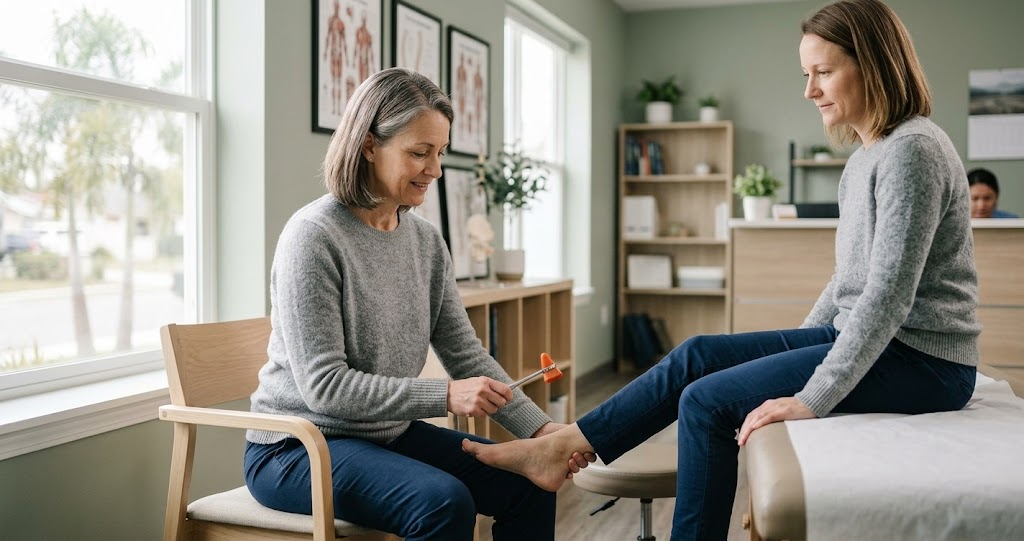
What Tests Does Dr. Betty Bampoe Perform to Evaluate Possible Sciatic Nerve Compression?
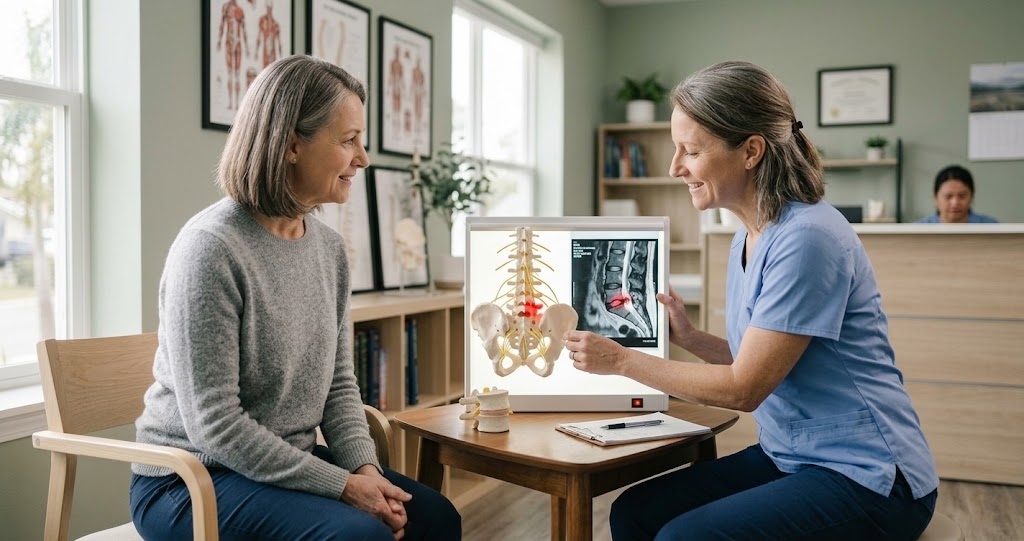
I Was Diagnosed With an L4-L5 Herniated Disc on MRI — Is Chiropractic Care Safe?
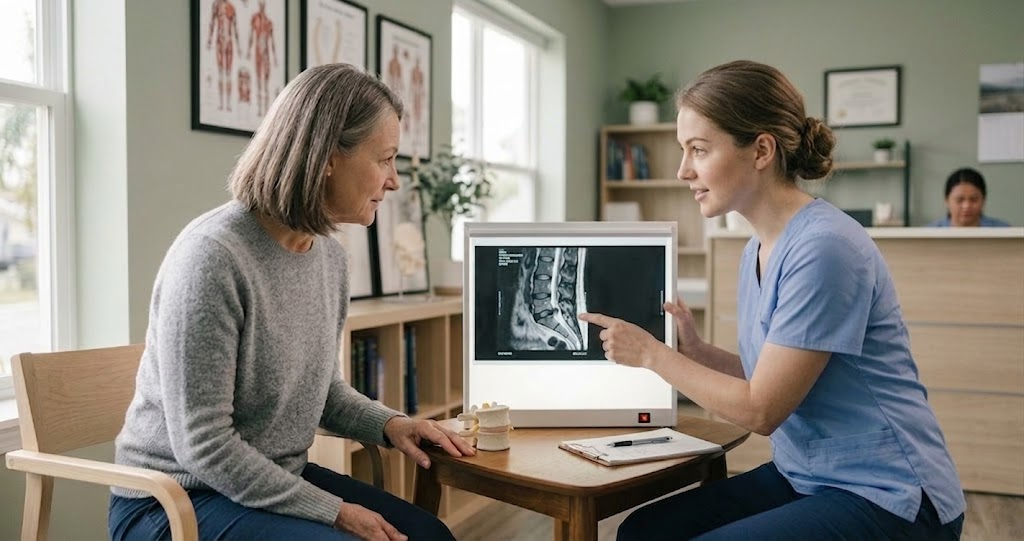
Your MRI Report Says "Disc Protrusion" — What Does That Actually Mean, and Will Anyone Explain It to You?