I Was Diagnosed With an L4-L5 Herniated Disc on MRI — Is Chiropractic Care Safe?
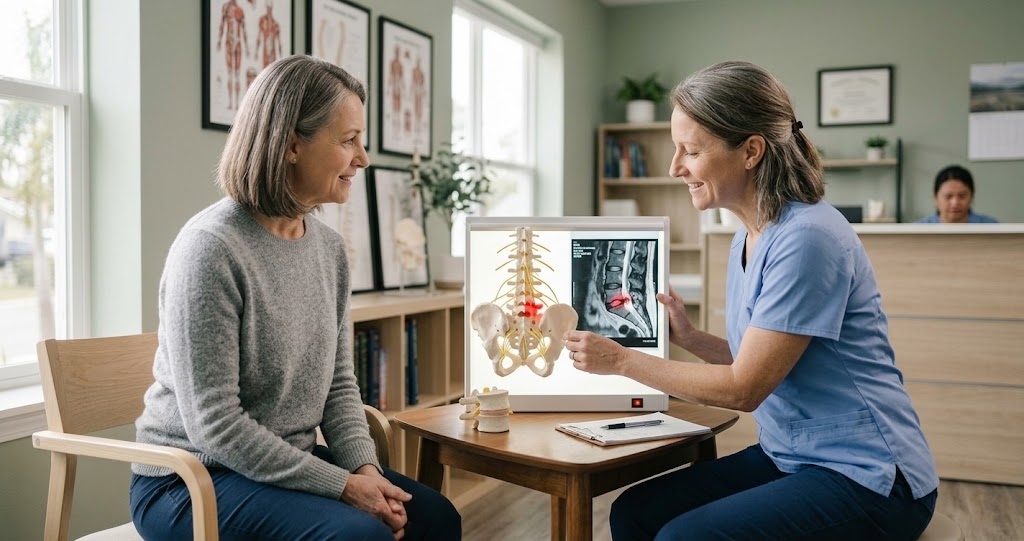
The word "herniated" on a radiology report can sound like a verdict. It isn't one. It's a starting point for a conversation that hasn't happened yet — the one where someone actually looks at you, not just the scan.
When a patient brings an MRI showing a herniated disc, Dr. Betty doesn't treat the label on the report — she treats the person in front of her. L4-L5 is, in fact, one of the two most common levels for this to happen: roughly 95 percent of all lumbar disc herniations occur at either L4-L5 or L5-S1 (StatPearls, NCBI/NIH, 2023). That means an L4-L5 diagnosis, however alarming it feels in the moment, is landing exactly where these things usually land — not an unusual or especially severe location on its own. Whether an adjustment is appropriate depends on what a full evaluation finds, not on the word printed on the report.
How Does Dr. Betty Approach an MRI-Confirmed L4-L5 Herniation?
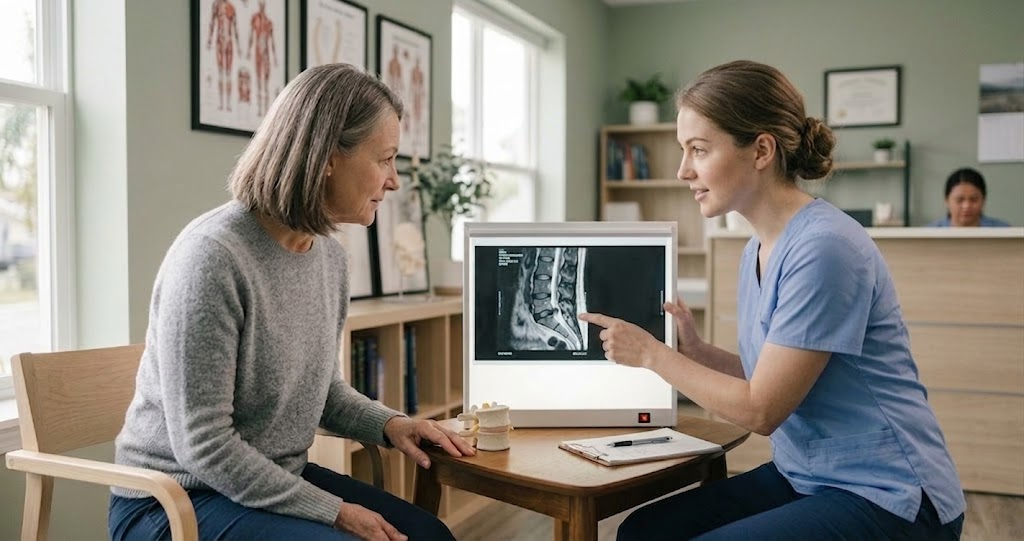
She starts with the MRI report, then the specific symptoms: where the pain travels, what movements aggravate or ease it, and any weakness or numbness — plus a full neurological exam, since an MRI finding and current symptoms don't always match up perfectly. Some people have a herniation on imaging and very mild symptoms; others have severe symptoms with a smaller finding. The report starts the conversation. The exam decides the plan.
When a patient brings me an MRI showing a herniated disc, I don't treat the label on the report, I treat the person in front of me. I start with the MRI itself, then I look closely at their actual symptoms, where the pain travels, what movements make it better or worse, and whether there's any weakness or numbness.
Why Doesn't an MRI Finding Alone Decide Whether Adjustments Are Safe?
Because the finding and the felt experience are two different pieces of information, and research consistently shows they don't move together in lockstep. Disc findings — including herniations, bulges, and degeneration — show up often on imaging in people with no back symptoms at all, and the reverse is also true: some patients with a large finding on MRI have only mild symptoms, while others with a modest finding are in significant pain. That mismatch is exactly why Dr. Betty looks past the report to your actual symptoms, movements, and neurological findings before deciding anything about adjustment.
Is L4-L5 a Common Level for a Herniated Disc, or Is My Case Unusual?
Common — genuinely one of the two most typical levels this occurs at. Roughly 95 percent of lumbar disc herniations happen at L4-L5 or L5-S1 combined, according to a widely cited clinical reference (StatPearls, NCBI/NIH, 2023). An L4-L5 diagnosis on its own doesn't mark your case as unusually severe or complicated — it marks it as landing in the most typical location, which is precisely where evaluation protocols and conservative care approaches are best established.
Can a Herniated Disc Improve on Its Own Over Time?
For many people, yes — a genuinely hopeful and well-documented finding worth knowing. A 2022 clinical practice guideline summary reported a meta-analysis finding spontaneous resorption — the herniated material shrinking or disappearing on its own over time — in roughly two-thirds of cases studied, and noted that L4-L5 and L5-S1, the most common herniation levels, also show among the highest rates of this natural resorption (Shiga, 2022). That doesn't mean every herniation resolves on its own, or that conservative care is unnecessary while it does. It does mean an L4-L5 diagnosis is not automatically a permanent or worsening condition — bodies often work on this problem in the background while a care plan addresses the symptoms in the meantime.
How Does Dr. Betty Address the Fear That an Adjustment Could Make It Worse?
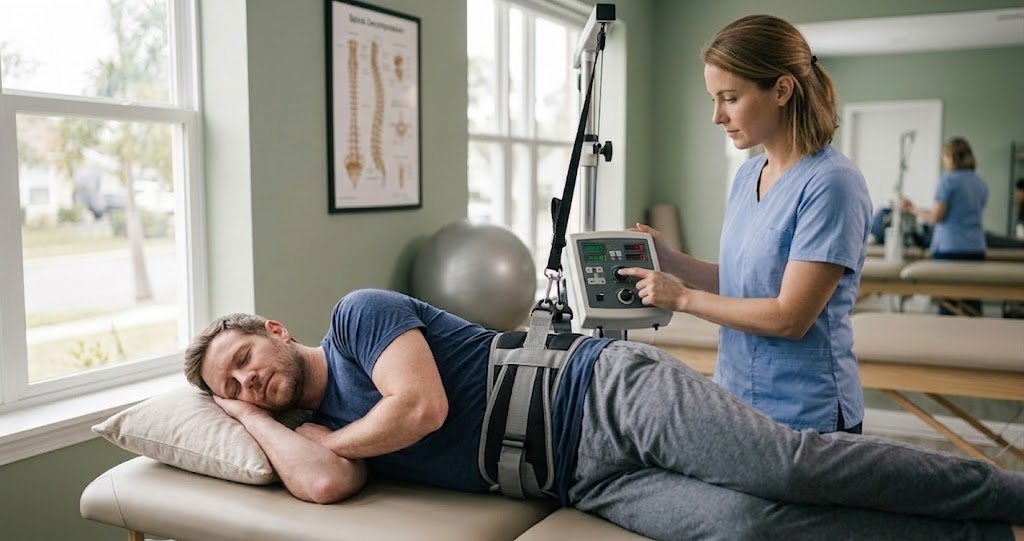
That fear is valid, and it's one reason evaluation always comes first. Depending on findings, some patients are appropriate for gentle, modified techniques or decompression, while others aren't a good fit for adjustment and are referred elsewhere. Dr. Betty doesn't apply one approach to everyone carrying a herniation label — the safety evidence on spinal manipulation for lumbar disc herniation is strong when appropriately matched to the patient, with serious complications estimated at less than 1 in 3.7 million manipulations in one systematic review (Oliphant, 2004), but that population-level safety record doesn't substitute for an individual exam. It supports doing the exam carefully, not skipping it.
What Signs Would Make Dr. Betty Modify Care, Avoid Certain Techniques, or Refer Out?
Increasing weakness, non-resolving numbness, symptoms that worsen with conservative care, or any red-flag sign would change the approach immediately — either modifying the plan or referring back to your physician or a specialist. If at any point Dr. Betty sees those changes, she changes course immediately rather than continuing a plan that isn't working.
Which Symptoms Mean This Needs Immediate Care, Not a Scheduled Visit?
Seek immediate medical evaluation if you have:
- Loss of bladder or bowel control
- Numbness in the groin, inner thighs, or saddle area
- Rapidly worsening leg weakness
- A foot that suddenly cannot lift, so it drags or slaps the floor
Those symptoms call for immediate medical evaluation, not a scheduled chiropractic visit. Go to an urgent care or emergency room, or call 911 if symptoms are severe.
A practical first step for everything short of that: take the OKC Sciatica Check at OKCSciaticaCheck.com before your visit — it takes a few minutes and helps Dr. Betty's team understand your pattern, MRI in hand or not, before you walk in.
How Is Treating the Person Different From Treating the MRI Report?
| Treating the MRI Report | Dr. Betty's Person-First Approach |
|---|---|
| Same care plan for every "L4-L5 herniation" label | Care matched to your specific symptoms, movements, and neuro findings |
| Assuming a herniation on imaging means severe, permanent damage | Recognizing imaging findings and felt symptoms don't always match |
| No plan for what happens if symptoms change | Care changed immediately if weakness increases or numbness doesn't resolve |
| One technique applied regardless of exam findings | Gentle, modified technique, decompression, or referral — chosen by findings |
| Fear of adjustment addressed with reassurance alone | Fear addressed with an actual exam and real safety evidence |
Both approaches start with the same three letters on a report. Only one actually looks past them.
Who Should I Call in OKC With an MRI-Confirmed L4-L5 Herniation?
You have the MRI report and images. Bring both — Dr. Betty starts with the MRI, then compares it to your actual symptoms and exam findings.
You're nervous an adjustment could make it worse. That fear is common and valid; it's addressed with an exam, not dismissed with reassurance alone.
Symptoms have been getting worse, not better. Say so clearly — increasing weakness or non-resolving numbness changes the plan immediately.
Any red-flag symptom from the list above. Urgent care or the ER — not a wait-and-see decision, and not a scheduled chiropractic visit.
Wherever you start, if your case needs imaging follow-up, medical management, or a surgical opinion, Dr. Betty refers out and shares what she found, so you are not starting over with the next provider.
Take the Next Steps at OKCSciaticaCheck.com
A diagnosis on a page is not the same thing as a plan. The word "herniated" describes what a scan captured on one day — it doesn't describe you, your movement, your strength, or what happens next. That part still needs an actual conversation.
References
- Lumbar Disc Herniation. StatPearls [Internet]. National Center for Biotechnology Information, National Institutes of Health. Updated 2023. https://www.ncbi.nlm.nih.gov/books/NBK560878/
- Shiga, Y. (2022). The Essence of Clinical Practice Guidelines for Lumbar Disc Herniation, 2021: 1. Epidemiology and Natural Course. Spine Surgery and Related Research, 6(4), 319–324. https://pmc.ncbi.nlm.nih.gov/articles/PMC9381076/
- Oliphant, D. (2004). Safety of spinal manipulation in the treatment of lumbar disk herniations: a systematic review and risk assessment. Journal of Manipulative and Physiological Therapeutics, 27(3), 197–210. https://pubmed.ncbi.nlm.nih.gov/15129202/
Frequently Asked Questions
Does an L4-L5 herniated disc diagnosis mean surgery is inevitable?
No. Many herniations, including at L4-L5, respond to conservative care, and a meaningful share show spontaneous resorption over time (Shiga, 2022). Surgery is one possible path, not an automatic outcome of the diagnosis itself.
Will a chiropractic adjustment make my herniated disc worse?
Not necessarily, and for many patients the safety evidence is strong — but not every technique fits every patient. That fear is valid, which is why evaluation always comes first: some patients are appropriate for gentle, modified techniques or decompression, while others are referred elsewhere based on exam findings.
Why does Dr. Betty want to see my actual MRI images, not just the report?
Because imaging findings and how someone actually feels don't always line up perfectly. Reviewing the images alongside your specific symptoms and exam results gives a fuller picture than the written report alone.
Is L4-L5 a worse level to herniate than other parts of the spine?
Not inherently. L4-L5 and L5-S1 together account for roughly 95 percent of lumbar disc herniations, making it the most typical location rather than an unusually severe one (StatPearls, 2023).
What would make Dr. Betty stop conservative care and refer me elsewhere?
Increasing weakness, numbness that isn't resolving, symptoms that worsen with conservative care, or any red-flag sign. Any of those would change the approach immediately.
This article is for general education only and is not a diagnosis, medical advice, or a treatment recommendation. It does not create a doctor-patient relationship. Symptoms cannot be diagnosed from an article. If you have severe or worsening symptoms — especially loss of bladder or bowel control, numbness in the groin or inner thighs, or progressive leg weakness — seek emergency care right away.
Ready for a Reasonable First Step?
Use the free, non-diagnostic Next-Step Checker, or call Precision Care Chiropractic in Oklahoma City to ask about an in-person evaluation.
Keep Reading

Shooting Pain That Travels Past Your Knee Into Your Ankle: Is Chiropractic Care Safe If It's a Disc?

Do You Need an MRI Before a Conservative Clinic in OKC Will See You for Sciatica?
Your MRI Report Says "Disc Protrusion" — What Does That Actually Mean, and Will Anyone Explain It to You?