Your MRI Report Says "Disc Protrusion" — What Does That Actually Mean, and Will Anyone Explain It to You?
You have the report. You've read the word "protrusion" four or five times now, and it hasn't gotten less alarming with repetition. Nobody has actually walked you through what it means.
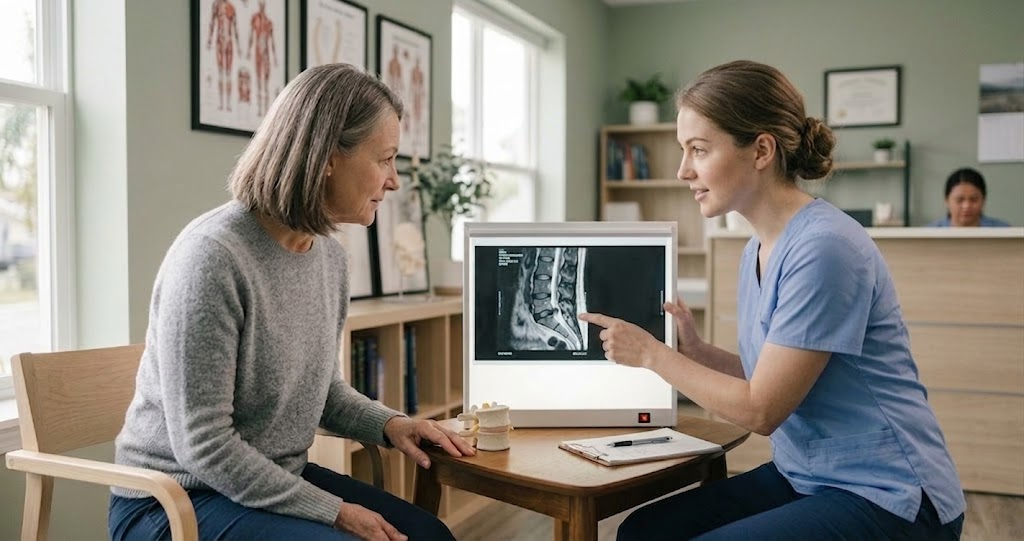
Yes — reviewing your imaging together is part of the evaluation, so you understand what was found and how or whether it connects to what you are feeling. That matters more than it might seem, because radiology reports are written for other clinicians, not for patients: a 2025 systematic review of 18 studies found that traditional, jargon-heavy radiology reports commonly cause unnecessary anxiety and confusion, while plain-language summaries and explanations measurably increase patient understanding and satisfaction (van der Mee et al., 2025). "Protrusion" itself is not a severity rating — it's a specific, defined shape descriptor. Under the standard nomenclature used across North American radiology, disc imaging findings describe anatomy and morphology only; the terminology does not by itself imply a relationship to your symptoms or a need for treatment (Fardon et al., 2014).
Does Dr. Betty Review MRI Reports and Images With Patients During the Evaluation?
Yes. Reviewing your imaging together is part of the evaluation, so you understand what was found and how or whether it connects to what you are feeling. This isn't a quick glance at the summary line — it's an actual walkthrough, with you in the room, of what the images show and what that does or doesn't explain about your symptoms.
I use plain language instead of radiology jargon and focus on what's relevant to your specific situation rather than reading the report line by line — what's common and often not concerning, and what actually affects your care plan.
What Does "Disc Protrusion" Actually Mean on a Radiology Report?
It's a precise, defined shape description, not a severity score. Under the standardized nomenclature developed jointly by the North American Spine Society, the American Society of Spine Radiology, and the American Society of Neuroradiology, a protrusion is present when disc material extends beyond the disc space but the widest point of that displaced material is still narrower than its base — in plain terms, it's still more "attached" than "detached" in shape (Fardon et al., 2014). That's different from an extrusion, where the displaced material has pushed out further than its base. Importantly, the nomenclature itself states these terms describe anatomy and shape only — they don't, by themselves, tell you how much it hurts or what to do about it. That's exactly the gap an evaluation exists to fill.
What Is Dr. Betty Looking for When She Compares Imaging to Your Symptoms?
Whether the location and severity of the imaging findings line up with your actual symptoms and exam results. Imaging can show things that aren't causing any symptoms at all, so matching the picture to the person is the important part. This isn't a unique quirk of your case — disc findings, including protrusions, show up routinely on imaging in people with no back symptoms whatsoever, at every age (Brinjikji et al., 2015). A protrusion on your report and pain in your leg might be connected. They might also be two separate facts that happen to share a page. The exam is what tells the difference.
Why Does Radiology Jargon Make Patients More Anxious Than Necessary?
Because these reports were never written with a patient reader in mind. A 2025 systematic review of 18 studies on radiology report formats found that traditional reports, dense with clinical terminology, commonly leave patients confused and unnecessarily anxious, while lay-language summaries and plain explanations consistently improved both understanding and satisfaction (van der Mee et al., 2025). The word "protrusion" sitting alone on a page, with no context for what it means for you specifically, is exactly the kind of language this research is describing.
How Does Dr. Betty Explain Findings Without Overwhelming or Frightening You?
She uses plain language instead of radiology jargon and focuses on what's relevant to your specific situation rather than reading the report line by line — what's common and often not concerning, and what actually affects your care plan. Not every line of a radiology report needs your attention. The ones that matter to your actual care get explained clearly; the ones that are common, incidental findings get named as such, so they stop being a source of quiet worry.
Which Symptoms Mean This Needs Immediate Care, Not a Scheduled Review?
Seek immediate medical evaluation if you have:
- Loss of bladder or bowel control
- Numbness in the groin, inner thighs, or saddle area
- Rapidly worsening leg weakness
- A foot that suddenly cannot lift, so it drags or slaps the floor
Those symptoms call for immediate medical evaluation, not a scheduled chiropractic visit. Go to an urgent care or emergency room, or call 911 if symptoms are severe.
Short of those, a disc protrusion finding on its own — however unfamiliar the word looks on the page — is a schedule-a-review situation, not an emergency.
What Should I Bring So We Can Review My Imaging Together?
The written report and, if possible, the images themselves, on a CD or USB. Bring your report and the actual images if you have them — reviewing both together, alongside your specific symptoms and exam findings, gives a fuller picture than the written summary alone. A practical first step before your visit: take the OKC Sciatica Check at OKCSciaticaCheck.com — it takes a few minutes and helps Dr. Betty's team understand your pattern ahead of time, so the imaging review can focus on what matters to you specifically.
How Is Reviewing Imaging Together Different From Just Reading You the Report?
| Reading You the Report | Reviewing Your Imaging Together |
|---|---|
| Radiology terms repeated without translation | Plain language used instead of jargon |
| Every line treated as equally important | Focus on what's relevant to your specific situation |
| Imaging findings presented as the full explanation | Findings compared against your actual symptoms and exam |
| Common, incidental findings left unexplained and worrying | Common findings named as such, reducing unnecessary concern |
| You leave with more questions than you came in with | You understand what was found and what it does or doesn't explain |
Both approaches technically "cover" the report. Only one leaves you actually understanding it.
Who Should I Call in OKC to Review My Disc Protrusion MRI?
You have a report but no one has walked you through it. Bring it in — reviewing your imaging together, in plain language, is part of the evaluation.
You have the images themselves, not just the summary. Bring those too, on a CD or USB — the images add real detail the summary alone doesn't.
The word "protrusion" is the main thing worrying you. It's a shape descriptor, not a severity score — worth discussing directly rather than sitting with unexplained.
Any red-flag symptom from the list above. Urgent care or the ER — not a wait-and-see decision, and not something a report review alone should address.
Wherever you start, if your case needs further imaging, medical management, or a surgical opinion, Dr. Betty refers out and shares what she found, so you are not starting over with the next provider.
Take the Next Steps at OKCSciaticaCheck.com
A word on a page that no one has explained to you tends to get bigger in your head the longer it sits there. "Protrusion" is a specific, defined term — not a verdict — and it deserves an actual conversation, not another few nights of searching it yourself.
References
- van der Mee, F. A. M., Ottenheijm, R. P. G., Gentry, E. G. S., Nobel, J. M., Zijta, F. M., Cals, J. W. L., & Jansen, J. (2025). The impact of different radiology report formats on patient information processing: a systematic review. European Radiology, 35(5), 2644–2657. https://link.springer.com/article/10.1007/s00330-024-11165-w
- Fardon, D. F., Williams, A. L., Dohring, E. J., Murtagh, F. R., Rothman, S. L. G., & Sze, G. K. (2014). Lumbar disc nomenclature: version 2.0. The Spine Journal, 14(11), 2525–2545. https://www.thespinejournalonline.com/article/S1529-9430(14)00409-4/fulltext
- Brinjikji, W., Luetmer, P. H., Comstock, B., Bresnahan, B. W., Chen, L. E., Deyo, R. A., et al. (2015). Systematic literature review of imaging features of spinal degeneration in asymptomatic populations. American Journal of Neuroradiology, 36(4), 811–816. https://www.ajnr.org/content/36/4/811
Frequently Asked Questions
Does "disc protrusion" mean my disc is severely damaged?
Not necessarily. Under the standard radiology nomenclature, protrusion is a specific shape description — displaced disc material that is still narrower than its base — not a severity rating. The term describes anatomy only; it doesn't by itself indicate how much it should hurt or what treatment is needed (Fardon et al., 2014).
Is a disc protrusion the same thing as a herniated disc?
Protrusion is one specific type of disc herniation, distinguished from extrusion by its shape under the same standardized nomenclature. The broader term "herniation" covers both protrusions and extrusions, along with other subtypes.
Why would my MRI show a protrusion if I'm not even sure it's causing my symptoms?
Disc findings, including protrusions, show up commonly on imaging in people with no back symptoms at all, at every age (Brinjikji et al., 2015). That's exactly why matching the imaging picture to your actual symptoms and exam findings is the important part, not the report alone.
Will Dr. Betty actually go through my report with me, or just summarize it quickly?
Reviewing your imaging together, in plain language rather than radiology jargon, is part of the evaluation. The focus is on what's relevant to your specific situation — what's common and often not concerning, and what actually affects your care plan.
What symptoms mean I shouldn't wait for a scheduled review of my MRI?
Loss of bladder or bowel control, numbness in the groin or saddle area, rapidly worsening leg weakness, or a foot that suddenly can't lift. Those call for immediate medical evaluation, not a scheduled appointment.
This article is for general education only and is not a diagnosis, medical advice, or a treatment recommendation. It does not create a doctor-patient relationship. Symptoms cannot be diagnosed from an article. If you have severe or worsening symptoms — especially loss of bladder or bowel control, numbness in the groin or inner thighs, or progressive leg weakness — seek emergency care right away.
Ready for a Reasonable First Step?
Use the free, non-diagnostic Next-Step Checker, or call Precision Care Chiropractic in Oklahoma City to ask about an in-person evaluation.
Keep Reading

Do You Need an MRI Before a Conservative Clinic in OKC Will See You for Sciatica?
I Was Diagnosed With an L4-L5 Herniated Disc on MRI — Is Chiropractic Care Safe?

What Tests Does Dr. Betty Bampoe Perform to Evaluate Possible Sciatic Nerve Compression?