Why Does My Foot or Big Toe Go Numb When I Sit or Drive?
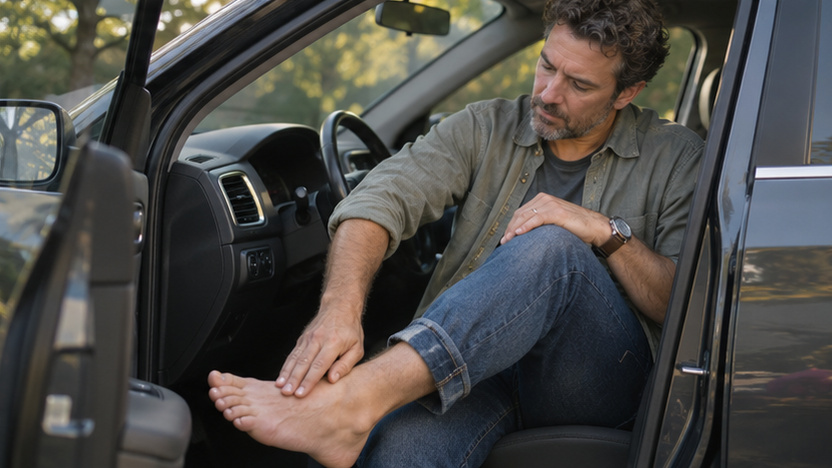
It starts a while into the drive, or after an hour at your desk. Your foot, or just your big toe, goes numb or starts to buzz, and it usually eases once you stand up and walk around. That pattern is easy to dismiss. It is also worth understanding.
When a nerve is already irritated, staying in one position for a long time can make it worse. If a disc problem in your lower back is affecting a nerve root, numbness can show up in the areas that nerve supplies, including the foot or toes. A Mayo Clinic Health System neurosurgeon describes the same pattern: a compressed nerve root causes pain, numbness, and sometimes weakness, and prolonged sitting can aggravate the symptoms (Schiefer, 2021). But not every numb foot starts in the spine. A nerve outside the spine can be pressed too, which is why Dr. Betty examines before she assumes.
Why Does My Foot or Big Toe Go Numb When I Sit or Drive?
Because a long drive or a long stretch at a desk means holding one position for a long time, and sitting can keep an already irritated nerve irritated. If a nerve root in your lower back is the source, the numbness is felt in the areas that nerve supplies, which can include your foot or toes. In that case the position is often the trigger rather than the cause.
Sitting can aggravate an already irritated nerve, especially when you stay in one position for a long time. If a disc problem in your lower back is affecting a nerve root, you may notice numbness in the areas that nerve supplies, including your foot or toes. Sometimes pressure on a nerve outside the spine can also contribute. So I would not assume that every numb foot is caused by a disc problem. I would want to know how quickly the numbness starts, whether it improves when you stand or walk, and whether you also notice weakness.
Does the Part of My Foot That Goes Numb Show Which Nerve Is Involved?
It can point in a direction. According to the same Mayo neurosurgeon, L5 radiculopathy is usually associated with numbness down the side of the leg and into the top of the foot, while S1 radiculopathy typically causes numbness down the back of the leg into the outside or bottom of the foot (Schiefer, 2021). Treat that as a rough guide. In a study of patients with MRI-confirmed L5 or S1 root compression, real pain patterns only approximated the published sensory maps, and clinicians could not identify the involved root from pain drawings any better than chance (Albert et al., 2019). Those findings concern pain rather than numbness, but the caution carries over: where it goes numb is a clue, not a verdict.
Can a Nerve Outside My Spine Make My Foot Go Numb When I Sit?
Yes. Dr. Betty is direct about it: sometimes pressure on a nerve outside the spine can also contribute, and as she puts it, “So I would not assume that every numb foot is caused by a disc problem.”
The best-documented example sits at the knee. The peroneal, or common fibular, nerve wraps around the head of the fibula just under the skin, and compression there is the most common entrapment neuropathy of the lower limb, ranking third among all such neuropathies after the ulnar and median nerves (Afacan et al., 2025). In one 2025 case report, a man developed foot numbness and foot drop after sitting cross-legged on a hard surface for two to three hours without changing position, and he had recovered completely within a month of conservative care. It is an unusual case, but it shows that a sustained posture alone can compress a nerve outside the spine.
The overlap runs both ways. A StatPearls chapter on foot drop notes that although foot symptoms are often associated with L5 radiculopathy, the lumbosacral plexus, the sciatic nerve, or the common fibular nerve may be involved instead (Nori & Stretanski, 2025). None of this means your numbness is peroneal. It means the question stays open until someone examines you.
What Does Dr. Betty Want to Know About My Numbness?
Three things:
- How quickly the numbness starts
- Whether it improves when you stand or walk
- Whether you also notice weakness
Then she checks your sensation, strength, and reflexes to help determine where the problem may be coming from before recommending care. Sensation shows what you can feel, strength shows whether the nerve is delivering its signal to the muscles, and reflexes show how the nerve pathway is responding, which together say far more than a description of tingling can.
Is It Safe to Keep Driving if My Foot Goes Numb?
If the numbness affects your ability to feel or safely control the pedals, do not continue driving.
- On longer trips, take breaks when it is safe to stop. New or worsening weakness needs urgent medical evaluation.
The reason is practical, not theoretical. A Mayo Clinic Health System neurosurgeon notes that weakness is less common than pain and numbness with a compressed nerve root, but when it happens it can matter at the wheel: L5 involvement can weaken the muscles that lift the foot, and in severe cases cause foot drop, while S1 involvement can weaken the push you use on a gas pedal (Schiefer, 2021). If you cannot feel or control the pedals reliably, the numbness has stopped being a nuisance and become a safety issue.
Which Symptoms Mean a Numb Foot Can't Wait for a Scheduled Visit?
Get medical care now if you have:
- New or worsening leg weakness, including a foot that starts dragging or trouble lifting the front of your foot
- New difficulty urinating, loss of bowel or bladder control, or numbness around the groin, genitals, or inner thighs (the saddle area)
- Severe or worsening weakness or numbness in both legs
- Sudden major loss of feeling in your leg
- Back pain with fever, chills, or feeling generally unwell
- Unexplained weight loss alongside persistent back pain
Those symptoms call for immediate medical evaluation, not a scheduled chiropractic visit. Go to an urgent care or emergency room, or call 911 if symptoms are severe.
Weakness deserves particular respect. The Mayo neurosurgeon notes that when weakness such as foot drop is significant, the sooner pressure is taken off the nerve, the more likely a full recovery (Schiefer, 2021). Numbness that comes and goes with sitting, without weakness, is a schedule-an-evaluation situation. A practical first step is to take the OKC Sciatica Check at OKCSciaticaCheck.com, which helps you organize what you are feeling before your visit.
How Is Assuming a Cause Different From Being Examined?
| Assuming One Cause Without an Exam | Dr. Betty's Evaluation-First Approach |
|---|---|
| Assuming every numb foot comes from a disc problem | Considering a nerve root in the spine and pressure on a nerve outside the spine |
| Blaming the seat or your posture alone | Treating sitting as a possible trigger, and asking how quickly the numbness starts and whether standing or walking helps |
| Ignoring numbness that goes away when you stand | Treating the on-and-off pattern as useful information |
| Guessing the nerve from where it tingles | Checking sensation, strength, and reflexes |
| Driving on and hoping it passes | Not continuing to drive if the numbness affects feeling or controlling the pedals |
Both approaches start from the same numb foot. Only one finds out why.
What Should I Do Next if My Foot Goes Numb When I Sit or Drive?
Notice how quickly the numbness starts, whether standing or walking helps, and whether you feel any weakness, and check yourself against the red-flag list. If you drive, take breaks on longer trips when it is safe to stop, and stop driving if you cannot feel or control the pedals reliably. You do not need to know whether it is your spine, your seat, or a nerve elsewhere before you call; that is what the evaluation is for. If the numbness is becoming more frequent, lasting longer, or interfering with your sleep, walking, work, or daily activities, that is reason enough to schedule. You can call or text the office, or book online, and the team is glad to answer questions before you schedule anything.
Take the Next Steps at OKCSciaticaCheck.com
Numbness that comes and goes is easy to live with, and that is exactly why it gets ignored. The point is not to alarm you. It is to find out whether the cause is in your spine or somewhere else along the nerve while the picture is still simple, and to know the moment it stops being simple.
- Precision Care Chiropractic — 5850 W Wilshire Blvd, Oklahoma City, OK 73132
- Call or text: (405) 803-8770
- Book online: precisioncarechiropractic.com/new-patient-form
- Take the next steps at OKCSciaticaCheck.com.
References
- Schiefer, T. K. (2021, July 9). Sciatica and radiculopathy: Peculiar names for shooting back, leg pain. Speaking of Health, Mayo Clinic Health System. https://www.mayoclinichealthsystem.org/hometown-health/speaking-of-health/sciatica-and-radiculopathy-peculiar-names
- Nori, S. L., & Stretanski, M. F. Foot Drop. StatPearls [Internet]. National Center for Biotechnology Information, National Institutes of Health. Updated May 1, 2025. https://www.ncbi.nlm.nih.gov/books/NBK554393/
- Afacan, M. Y., Ozturk, B., Akbaba, D., Sahin, A. N., & Ozsahin, M. K. (2025). Complete recovery from acute peroneal nerve palsy with neurapraxia after prolonged cross-legged sitting: successful conservative management of a foot drop and a brief review of the literature. Cureus, 17(2), e78465. https://doi.org/10.7759/cureus.78465
- Albert, H. B., Hansen, J. K., Sogaard, H., & Kent, P. (2019). Where do patients with MRI-confirmed single-level radiculopathy experience pain, and what is the clinical interpretability of these pain patterns? A cross-sectional diagnostic accuracy study. Chiropractic & Manual Therapies, 27, 50. https://doi.org/10.1186/s12998-019-0273-8
Frequently Asked Questions
Why does my foot or big toe go numb when I sit or drive?
When a nerve is already irritated, staying in one position for a long time can make it worse. If a disc problem in the lower back is affecting a nerve root, numbness can show up in the areas that nerve supplies, including the foot or toes. A nerve outside the spine can also be involved, which is why an examination comes before any assumption.
Does numbness that goes away when I stand up mean it's nothing?
Not necessarily. A pattern that eases when you stand or walk is useful information, and Dr. Betty asks about it directly. It can point toward position-related irritation, but it does not tell you where the problem is coming from.
Isn't it just my seat or the way I sit?
Your position may well be the trigger, but a trigger is not a cause. The same numb foot can come from a nerve root in the lower spine or from pressure on a nerve elsewhere along its route. Take the OKC Sciatica Check at OKCSciaticaCheck.com to organize what you have noticed before your visit; the examination is what shows whether it is the seat, the spine, or a nerve outside the spine.
Could my numb foot be coming from a nerve outside my spine?
Yes, it is possible. Peroneal nerve entrapment at the fibular head is the most common entrapment neuropathy of the lower limb, and sustained postures such as prolonged cross-legged sitting can compress that nerve (Afacan et al., 2025). A StatPearls chapter on foot drop also notes that although foot symptoms are often associated with L5 radiculopathy, the lumbosacral plexus, sciatic nerve, or common fibular nerve may be involved instead (Nori & Stretanski, 2025).
What does Dr. Betty check when my foot goes numb?
She asks how quickly the numbness starts, whether it improves when you stand or walk, and whether you also notice weakness. Then she checks your sensation, strength, and reflexes to help determine where the problem may be coming from before recommending care.
Is it safe to keep driving if my foot goes numb?
If the numbness affects your ability to feel or safely control the pedals, do not continue driving. New or worsening weakness needs urgent medical evaluation. On longer trips, take breaks when it is safe to stop.
Are there symptoms with a numb foot that can't wait for a scheduled appointment?
New or worsening leg weakness, including a foot that starts dragging, needs urgent medical evaluation. New difficulty urinating, loss of bowel or bladder control, or numbness around the groin, genitals, or inner thighs calls for emergency evaluation. Back pain with fever, chills, or feeling generally unwell needs urgent medical assessment.
This article is for educational purposes only and is not medical advice, diagnosis, or treatment. It does not establish a doctor-patient relationship and does not guarantee any outcome or result. Individual results vary. Only an in-person evaluation by a qualified provider can determine what may be contributing to your symptoms and what care, if any, is appropriate for you. If you are experiencing any of the red-flag symptoms described in this article, seek immediate medical evaluation. If numbness affects your ability to feel or safely control the pedals, do not continue driving.
Ready for a Reasonable First Step?
Use the free, non-diagnostic Next-Step Checker, or call Precision Care Chiropractic in Oklahoma City to ask about an in-person evaluation.
Keep Reading

Why Does Driving Aggravate My Sciatica So Much?

Why Does Sciatica Pain Travel Below the Knee and Into Your Foot or Toes?

Can You Have Sciatica Even if You Barely Have Lower-Back Pain?