Radiating Leg Pain: Should You See a Chiropractor, PCP, Neurologist, or Spine Specialist First?

Five reasonable options, one phone call to make, and no obvious way to know which option is actually right for you. That stuck feeling is the whole reason this question gets searched so often.
The starting point comes down to how the pain showed up and what else is going on — not a universal rule that applies to everyone with radiating leg pain. If it feels mechanical, worse with certain positions, with no red-flag symptoms and no signs of serious injury, a conservative evaluation is a reasonable first step. If other health concerns complicate the picture, a primary care doctor makes sense first. If numbness or weakness is significant, a neurologist may be the better stop. If surgery has already come up, a spine specialist should be involved. The research backs up why there's no single right answer here: a classic study following over 1,500 patients with acute low back pain found that recovery times were similar whether people saw a primary care practitioner, a chiropractor, or an orthopedic surgeon — and patient satisfaction was actually highest among those who saw chiropractors (Carey et al., 1995, New England Journal of Medicine).
When Is Conservative Chiropractic Evaluation a Reasonable First Step?
When the pain feels mechanical — worse with certain positions, no red-flag symptoms, no major trauma — a conservative evaluation is a reasonable starting point to understand what's going on and whether conservative care fits. That's the majority of radiating leg pain cases people search about.
If your case needs imaging, medical management, or a surgical opinion, I refer you to the right specialist and share my findings so you're not starting over. Care isn't siloed — the goal is getting you to the right hands, even when that's not mine.
When Should I Start With a Primary Care Doctor Instead?
Start with a PCP if other health concerns complicate the picture — diabetes, cardiovascular issues, medications that interact with treatment options, or a general sense that something broader than the spine may be involved. A primary care doctor is well positioned to see the whole health picture before narrowing in on the leg pain specifically.
When Should I Start With a Neurologist Instead?
Start with a neurologist if numbness or weakness is significant — not mild tingling, but numbness that's spreading or weakness that's making it hard to lift the foot or bear weight normally. A neurologist can go further into nerve-specific testing when the neurological picture is the dominant concern from the outset.
When Should a Spine Specialist Be Involved From the Start?
Start with a spine specialist if surgery has already come up in conversation — whether from a prior provider, an ER visit, or an existing diagnosis. At that point, a surgical opinion should be part of the conversation early, not added in later.
Does the Research Show One Provider Type Gets Better Results Than Others?
No — and that's a genuinely useful thing to know before agonizing over the choice. The same 1995 New England Journal of Medicine study found that time to functional recovery, return to work, and complete recovery were similar across primary care practitioners, chiropractors, and orthopedic surgeons (Carey et al., 1995). A more recent 2016 systematic review of randomized controlled trials reached a similar conclusion, finding chiropractic care about as effective as physical therapy, exercise therapy, and medical care for low back pain, with no serious adverse events reported across any of the provider types studied — the review's own conclusion was that the choice should be guided by patient preference and values rather than a presumed superiority of one profession (Blanchette et al., 2016).
Which Symptoms Mean Urgent Care or the ER, Not Any of the Above?
Skip all of the above and go straight to urgent care or the ER if you have:
- Sudden weakness
- Saddle numbness
- Loss of bladder or bowel control
- Signs of a serious injury
That's not a wait-and-see decision, and it isn't a choice between the provider types discussed above.
Short of those symptoms, the decision genuinely is between the reasonable options above, matched to your specific pattern.
How Does Dr. Betty Collaborate or Refer When a Patient Needs Care Beyond Her Office?
If your case needs imaging, medical management, or a surgical opinion, Dr. Betty refers you to the right specialist and shares her findings so you're not starting over. Care isn't siloed — the goal is getting you to the right hands, even when that's not hers. That collaborative posture has support in the broader chiropractic literature: a 2016 clinical practice guideline concluded that doctors of chiropractic are well suited to diagnose, treat, co-manage, and manage the treatment of low back pain disorders, working alongside other providers rather than in competition with them (Globe et al., 2016).
How Is Matching the Provider to the Pattern Different From Picking Whichever Office Is Closest?
| Picking Whichever Provider Is Closest or Fastest | Matching the Provider to Your Specific Pattern |
|---|---|
| Same first call regardless of symptoms | First step matched to how the pain shows up and what else is going on |
| Assuming one provider type is objectively "better" | Recognizing research shows similar outcomes across reasonable options |
| Starting over completely if referred elsewhere | Findings shared with the next provider, so nothing is repeated unnecessarily |
| No plan if red flags appear mid-treatment | Red-flag screening built into every step, regardless of provider |
| Choice driven by guesswork | Choice driven by symptom pattern and, where evidence allows, personal preference |
Both approaches get you to a provider eventually. Only one gets you to the right one on the first try more often than not.
Who Should I Call in OKC to Start Figuring This Out?
Pain is mechanical, no red flags, no complicating health issues. A conservative evaluation with Dr. Betty is a reasonable, well-supported first step.
Other health concerns are part of the picture. Start with your primary care doctor, who can coordinate from there.
Numbness or weakness is significant. A neurologist may be the better first stop for a fuller neurological workup.
Surgery has already been discussed. A spine specialist should be involved from the start.
Any red-flag symptom. Urgent care or the ER — not a wait-and-see decision, and not a choice between the options above.
Wherever you start, if your case needs imaging, medical management, or a surgical opinion, Dr. Betty refers out and shares what she found, so you are not starting over with the next provider.
Take the Next Steps at OKCSciaticaCheck.com
The research is honestly reassuring here: there isn't a wrong reasonable choice, only a choice that fits your specific pattern better or worse. If a conservative evaluation fits yours, the sooner it happens, the sooner you have real information instead of five unopened options.
References
- Carey, T. S., Garrett, J., Jackman, A., McLaughlin, C., Fryer, J., & Smucker, D. R. (1995). The outcomes and costs of care for acute low back pain among patients seen by primary care practitioners, chiropractors, and orthopedic surgeons. The North Carolina Back Pain Project. New England Journal of Medicine, 333(14), 913–917. https://www.nejm.org/doi/full/10.1056/NEJM199510053331406
- Blanchette, M. A., Stochkendahl, M. J., Borges Da Silva, R., Boruff, J., Harrison, P., & Bussières, A. (2016). Effectiveness and economic evaluation of chiropractic care for the treatment of low back pain: a systematic review of pragmatic studies. PLoS ONE, 11(8), e0160037. https://journals.plos.org/plosone/article?id=10.1371/journal.pone.0160037
- Globe, G., Farabaugh, R. J., Hawk, C., Morris, C. E., Baker, G., Whalen, W. M., et al. (2016). Clinical practice guideline: chiropractic care for low back pain. Journal of Manipulative and Physiological Therapeutics, 39(1), 1–22.
Frequently Asked Questions
Is a chiropractor a legitimate first stop for radiating leg pain, or should I always see a doctor first?
A conservative evaluation is a reasonable first step when pain feels mechanical, with no red flags or major trauma. Research comparing outcomes across primary care practitioners, chiropractors, and orthopedic surgeons found similar recovery times across all three, with patient satisfaction highest among those who saw chiropractors (Carey et al., 1995).
Does research show physical therapy or medical care gets better results than chiropractic care?
Not according to the evidence reviewed. A systematic review of randomized controlled trials found chiropractic care about as effective as physical therapy, exercise therapy, and medical care for low back pain, with no serious adverse events reported (Blanchette et al., 2016). The review's own conclusion was that the choice should follow patient preference, not a presumed superiority of one approach.
If I start with a chiropractor and actually need a specialist, do I have to start over?
No. If your case needs imaging, medical management, or a surgical opinion, Dr. Betty refers you to the right specialist and shares her findings, so you're not starting over. This collaborative approach is supported in the broader chiropractic literature as well (Globe et al., 2016).
How do I know if my numbness or weakness counts as "significant" enough for a neurologist?
A general guide: mild tingling that comes and goes is different from numbness that's spreading or weakness that's affecting your ability to walk or lift your foot normally. If you're unsure, the OKC Sciatica Check can help organize the pattern, or a conservative evaluation can help determine whether referral to a neurologist makes sense.
What symptoms mean I shouldn't be choosing between any of these providers at all?
Sudden weakness, saddle numbness, loss of bladder or bowel control, or signs of a serious injury. Those call for urgent care or the ER immediately, not a decision between chiropractor, PCP, neurologist, or spine specialist.
This article is for general education only and is not a diagnosis, medical advice, or a treatment recommendation. It does not create a doctor-patient relationship. Symptoms cannot be diagnosed from an article. If you have severe or worsening symptoms — especially loss of bladder or bowel control, numbness in the groin or inner thighs, or progressive leg weakness — seek emergency care right away.
Ready for a Reasonable First Step?
Use the free, non-diagnostic Next-Step Checker, or call Precision Care Chiropractic in Oklahoma City to ask about an in-person evaluation.
Keep Reading

Which Sciatica Symptoms Mean You Should Skip the Chiropractor and Get Immediate Medical Care?
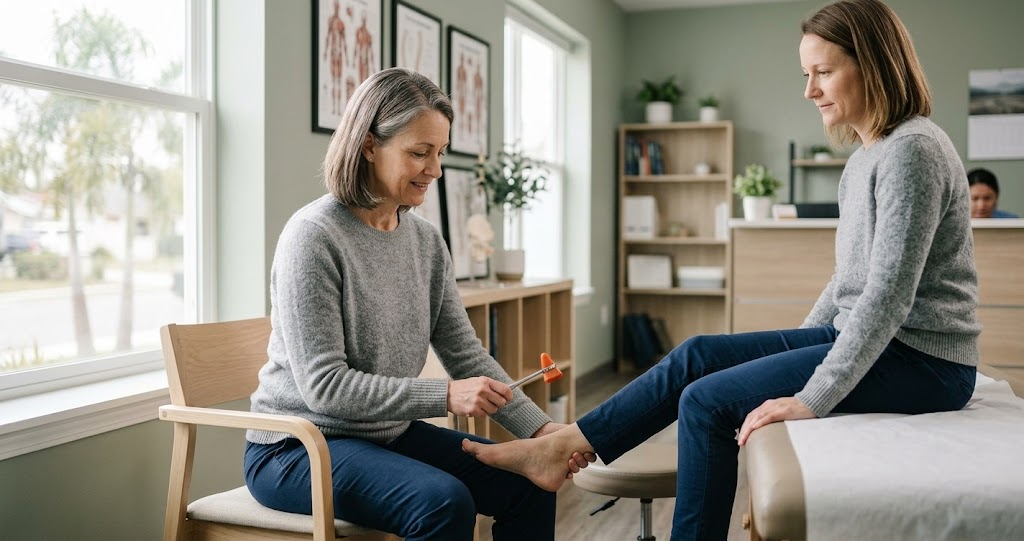
What Tests Does Dr. Betty Bampoe Perform to Evaluate Possible Sciatic Nerve Compression?

Chiropractor or Physical Therapist First for Radiating Leg Pain? How to Actually Decide