Is Chiropractic Care Safe if I Have a Bulging or Herniated Disc?

The word on the report was disc. Bulging, protruding, herniated, whichever term the radiologist used, it sounded structural and fragile, and a question followed that is easy to understand: if my disc is already injured, could an adjustment make it worse? You may have heard reassuring stories, and you may have heard frightening ones, and neither helps when it is your own back.
Dr. Betty Bampoe at Precision Care Chiropractic in Oklahoma City answers this question with a careful yes-and-no. Chiropractic care can be appropriate for some people with a disc problem, and it is not appropriate for everyone. The decision comes after an examination, not before it, and it stays under review once care begins. Safety here is less a verdict than a process.
Is Chiropractic Care Safe if I Have a Bulging or Herniated Disc?
It can be appropriate for some people, and Dr. Betty is careful to say some, not all. A disc finding on its own does not settle the question either way. What matters is the person in front of her: how the nerves are functioning, what the examination shows, and which techniques, if any, make sense. No treatment is risk-free, and a responsible answer starts there.
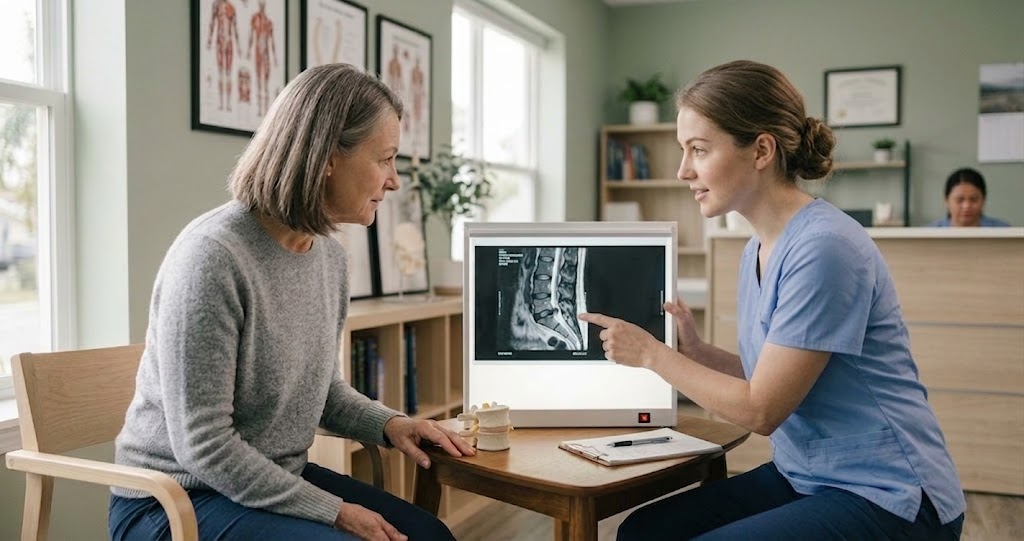
Chiropractic care can be appropriate for some people with a bulging or herniated disc. Having a disc problem does not automatically rule out chiropractic care, but the condition of your nerves and the techniques used matter. Before recommending treatment, I will examine you, check your strength, sensation, and reflexes, and review any relevant imaging. Those findings help me determine whether adjustments are appropriate, whether I need to modify my approach, or whether you need another provider. At Precision Care Chiropractic, our Disc & Sciatica Relief Program may combine chiropractic care with non-surgical spinal decompression when I determine it is appropriate. We have helped many patients improve, but no treatment is risk-free, and results vary. I also monitor how you respond. Increasing leg pain, numbness, or weakness calls for reassessment. Significant or progressive weakness, bowel or bladder changes, or saddle numbness require urgent medical evaluation rather than proceeding with adjustments.
Does a Disc Problem Automatically Rule Out Chiropractic Care?
No, and it does not automatically rule it in. Dr. Betty puts both halves together: “Having a disc problem does not automatically rule out chiropractic care, but the condition of your nerves and the techniques used matter.” Two things are doing the work in that sentence. The first is nerve function, because a nerve that is losing strength or sensation changes the plan. The second is technique, because "chiropractic care" covers a range of approaches, and not every approach suits every disc.
Many disc findings are also less definitive than they sound. A meta-analysis reviewed in a BMJ article found disc protrusion on MRI in 57% of people with symptoms and 34% of people without, so a disc finding is not always the whole explanation for pain (Jensen et al., 2019). That is one more reason a good evaluation looks at you, not only at the image.
What Does the Research Say About the Safety of Spinal Manipulation With a Disc Herniation?
The honest summary is that the available evidence is encouraging but limited. A 2004 systematic review and risk assessment of manipulation for lumbar disc herniation estimated the risk of a serious complication, worsened herniation or cauda equina syndrome, at less than 1 in 3.7 million manipulations. The author, a chiropractor writing in a chiropractic journal, described his inputs as rough estimates at best and noted that underreporting is a possibility (Oliphant, 2004).
A 2014 prospective cohort study followed 148 patients with MRI-confirmed lumbar disc herniation who received side-posture manipulation by a chiropractor. Most were rated improved at three months and at one year, and no serious adverse events were reported. The authors point out that it was an observational study from a single practice, without an untreated comparison group, so the outcomes cannot be attributed to the manipulation alone (Leemann et al., 2014).
In a 2019 BMJ meta-analysis of trials in chronic low back pain, most adverse events were musculoskeletal, transient, and mild to moderate, though many trials did not record adverse events systematically and one serious event was judged possibly related to manipulation (Rubinstein et al., 2019). None of these studies is a promise about your disc. Together they support taking an individual, evaluation-first approach, which is the one Dr. Betty describes.
What Does Dr. Betty Check Before She Recommends Any Treatment for a Disc Problem?
Her examination comes first, and it is specific:
- A full history of where your symptoms travel, when they started, and what makes them better or worse
- Strength, sensation, and reflexes, which show how the nerves are functioning
- Any relevant imaging you already have, reviewed alongside your findings
Then she decides one of three things: whether adjustments are appropriate, whether she needs to modify her approach, or whether you need another provider. That third option is not a failure of the visit. It is part of its purpose.
How Is an Evaluation-First Approach Different From Assuming a Disc Can or Can't Be Adjusted?
| Assuming a Disc Can or Can't Be Adjusted | Evaluating Before Care |
|---|---|
| Treating the word disc as a yes or no answer | Recognizing a disc problem does not automatically rule care in or out |
| Looking mainly at the image | Examining you and checking strength, sensation, and reflexes |
| Using one technique for every patient | Considering whether the approach needs to be modified |
| Continuing the plan regardless of response | Monitoring your response and reassessing if leg pain, numbness, or weakness increases |
| Staying in one office no matter what is found | Referring to another provider when findings call for it |
The word disc is the same in both columns. What happens next is different.
What Is the Disc & Sciatica Relief Program, and Is It Right for Everyone?
At Precision Care Chiropractic, the program may combine chiropractic care with non-surgical spinal decompression when Dr. Betty determines it is appropriate. She says that the practice has helped many patients improve, and she is equally clear that no treatment is risk-free and results vary. It is one option, offered after an evaluation, and it is not presented as right for everyone.
The evidence on non-surgical decompression and similar approaches deserves honesty too. A 2025 network meta-analysis of 50 trials in chronic sciatica concluded that the certainty of the evidence for non-surgical interventions was very low, with spinal manipulative therapy among those showing the largest short-term leg pain reductions against placebo, still with very low confidence (Journal of Pain, 2025). The next article in this series takes up decompression directly.
How Does Dr. Betty Monitor How My Body Responds?
Safety does not end at the first visit. Dr. Betty says she monitors how you respond, and that increasing leg pain, numbness, or weakness calls for reassessment. That means you are part of the monitoring: tell her what changed, when it changed, and how long it lasted. A plan that is working should be moving your leg symptoms, your sitting, sleeping, walking, and working in a better direction, not a worse one.
If you want to prepare before a visit, a practical first step is to take the OKC Sciatica Check at OKCSciaticaCheck.com, which helps you organize where your symptoms travel and what makes them better or worse. Bring any MRI report or images and a list of what you have already tried.
Which Symptoms Mean Adjustments Should Wait and Urgent Care Is Needed?
This is the safety line, and Dr. Betty states it without hedging: significant or progressive weakness, bowel or bladder changes, or saddle numbness need urgent medical evaluation, not a scheduled adjustment.
Get medical care now if you have:
- New or worsening leg weakness, including a foot that starts dragging or trouble lifting the front of your foot
- New difficulty urinating, loss of bowel or bladder control, or numbness around the groin, genitals, or inner thighs (the saddle area)
- Severe or worsening weakness or numbness in both legs
- Sudden major loss of feeling in your leg
- Back pain with fever, chills, or feeling generally unwell
- Unexplained weight loss alongside persistent back pain
Those symptoms call for immediate medical evaluation, not a scheduled chiropractic visit. Go to an urgent care or emergency room, or call 911 if symptoms are severe.
Take the Next Steps at OKCSciaticaCheck.com
A disc finding can make every next step feel risky, including doing nothing. The cost of guessing is making a decision about your back from a headline instead of an examination. Starting with someone who checks your nerves first, and who will tell you if you need another provider, is the safer way to find out.
- Precision Care Chiropractic — 5850 W Wilshire Blvd, Oklahoma City, OK 73132
- Call or text: (405) 803-8770
- Book online: precisioncarechiropractic.com/new-patient-form
- Take the next steps at OKCSciaticaCheck.com.
References
- Oliphant, D. (2004). Safety of spinal manipulation in the treatment of lumbar disk herniations: a systematic review and risk assessment. Journal of Manipulative and Physiological Therapeutics, 27(3), 197–210.
- Leemann, S., Peterson, C. K., Schmid, C., Anklin, B., & Humphreys, B. K. (2014). Outcomes of acute and chronic patients with magnetic resonance imaging-confirmed symptomatic lumbar disc herniations receiving high-velocity, low-amplitude, spinal manipulative therapy: a prospective observational cohort study with one-year follow-up. Journal of Manipulative and Physiological Therapeutics, 37(3), 155–163.
- Rubinstein, S. M., de Zoete, A., van Middelkoop, M., Assendelft, W. J. J., de Boer, M. R., & van Tulder, M. W. (2019). Benefits and harms of spinal manipulative therapy for the treatment of chronic low back pain: systematic review and meta-analysis of randomised controlled trials. BMJ, 364, l689. https://www.bmj.com/content/364/bmj.l689
- Effectiveness of non-surgical interventions for patients with chronic sciatica: A systematic review with network meta-analysis. (2025). The Journal of Pain, 33, 105431.
- Jensen, R. K., Kongsted, A., Kjaer, P., & Koes, B. (2019). Diagnosis and treatment of sciatica. BMJ, 367, l6273. https://doi.org/10.1136/bmj.l6273
Frequently Asked Questions
Can I see a chiropractor if I have a herniated disc?
Chiropractic care can be appropriate for some people with a disc problem, depending on an examination. Dr. Betty examines you, checks strength, sensation, and reflexes, and reviews any relevant imaging before recommending care.
Can a chiropractic adjustment make a herniated disc worse?
No treatment is risk-free. A 2004 risk assessment estimated serious complications from manipulation in disc herniation to be rare, but the author called the estimates rough and noted possible underreporting (Oliphant, 2004). That is why evaluation and monitoring matter.
What if the exam shows I shouldn't be adjusted?
Then you will be told. Dr. Betty considers whether adjustments are appropriate, whether her approach needs to change, or whether you need another provider, and that decision comes before treatment.
Will I be adjusted at my first visit?
Not automatically. The first visit centers on your history, your examination, and a review of any relevant imaging. Whether adjustments make sense is decided from those findings.
I'm worried about forceful adjustments. Can I talk about that first?
Yes. Bring that worry to the visit and ask how your care would be modified. If you want to organize your questions beforehand, take the OKC Sciatica Check at OKCSciaticaCheck.com.
What is the Disc & Sciatica Relief Program?
At Precision Care Chiropractic, it may combine chiropractic care with non-surgical spinal decompression when Dr. Betty determines it is appropriate. Results vary, and it is not right for everyone.
Which symptoms mean I should get urgent care instead?
Significant or progressive leg weakness, a foot that drags, new bowel or bladder changes, loss of bladder or bowel control, or numbness around the groin, genitals, or inner thighs need urgent or emergency medical evaluation rather than a scheduled adjustment.
This article is for educational purposes only and is not medical advice, diagnosis, or treatment. It does not establish a doctor-patient relationship and does not guarantee any outcome or result. Individual results vary. Only an in-person evaluation by a qualified provider can determine what may be contributing to your symptoms and what care, if any, is appropriate for you. If you are experiencing any of the red-flag symptoms described in this article, seek immediate medical evaluation.
Ready for a Reasonable First Step?
Use the free, non-diagnostic Next-Step Checker, or call Precision Care Chiropractic in Oklahoma City to ask about an in-person evaluation.
Keep Reading
Your MRI Report Says "Disc Protrusion" — What Does That Actually Mean, and Will Anyone Explain It to You?

Is Spinal Decompression Worth Trying, or Is It Just an Expensive Sales Pitch?

What Kind of Doctor or Provider Should I See First for Sciatica?