Do I Need an MRI Before Anyone Can Tell Me What to Do Next for Sciatica?

You have heard it from a friend, a coworker, maybe a search result: nothing can be done about sciatica until you get an MRI. So you wait, the leg keeps hurting, and the waiting starts to feel like part of the problem.
You do not always need an MRI before someone can work out the next step. Dr. Betty starts earlier than a scan: she listens, performs a thorough examination that includes checking your nerve function, and takes or reviews X-rays when appropriate. Clinical guidance supports that order of operations. The American College of Physicians advises against routine imaging for low back pain, recommends MRI for persistent radiculopathy only for people who are potential candidates for surgery or an epidural steroid injection, and reserves urgent imaging for severe or progressive neurologic deficits or suspected serious conditions (Chou et al., 2011). An MRI is a tool for a specific decision, not a ticket to be seen.
Do I Need an MRI Before Anyone Can Tell Me What to Do Next?
Not always. The next step can often be worked out from a conversation, an examination, and X-rays when they are appropriate, with an MRI added if and when it would change what happens next.
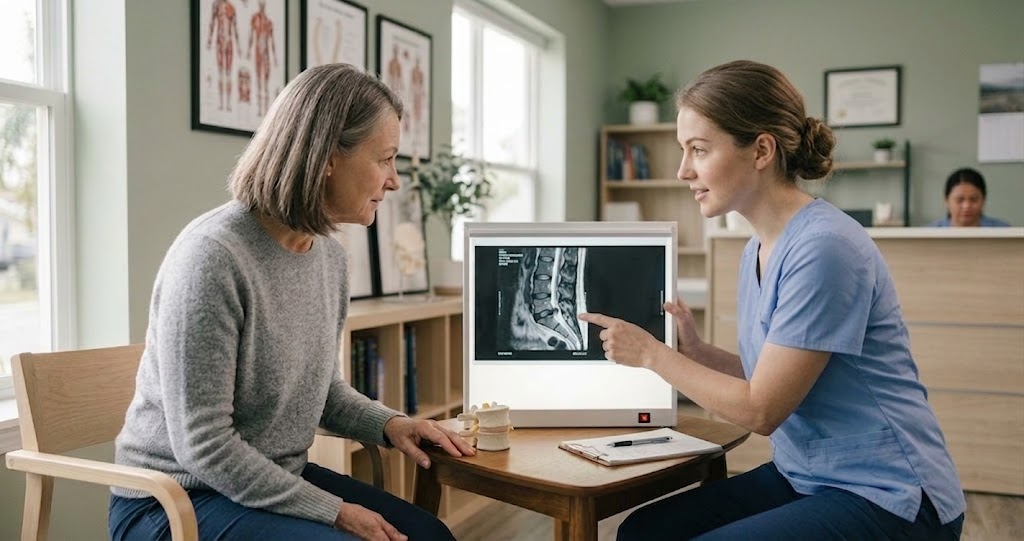
No, you do not always need an MRI before we can determine the next step. When you come to my office, I will listen to your concerns and what you are experiencing, then perform a thorough examination, including checking your nerve function. We also take or review X-rays when appropriate to assess the bones and joints of your spine. X-rays do not show the discs or nerves clearly, so I consider those findings alongside your symptoms and examination. If you are not responding to care as expected, I would reassess and request an MRI when it would help guide the next step.
What Does Dr. Betty Do Before Any MRI Is Considered?
She starts with you: your concerns and what you are experiencing, then a thorough examination that includes your nerve function. X-rays are taken or reviewed when appropriate, to assess the bones and joints of the spine. Precision Care has digital X-ray on site, so when imaging is clinically indicated many patients can be imaged the same day. MRI is not performed in the office, and when one is needed, patients are referred to imaging centers in the Oklahoma City area.
She is open about what X-rays cannot do, which is show the discs or nerves clearly. That is why she weighs any X-ray finding alongside your symptoms and your examination instead of treating it as an answer on its own.
What Does the Research Say About Imaging Before Starting Care?
It is more cautious than the "get a scan first" habit suggests. The ACP guidance behind the 2011 recommendations rests partly on a meta-analysis of six randomized trials, which found no outcome difference between routine imaging and usual care without immediate imaging in patients without signs of a serious condition (Chou et al., 2009; Chou et al., 2011). Clinical guidance for sciatica in the BMJ goes further, advising that patients not be referred for imaging unless pain increases suddenly, neurological deficits worsen, or surgery is being considered (Jensen et al., 2019).
Part of the reason is that images and symptoms do not line up neatly. A meta-analysis reviewed in that BMJ article reported disc protrusion on MRI in 57% of people with symptoms and in 34% of people without, and the authors describe disc herniations as common age-related findings that matter mainly when accompanied by sciatica (Jensen et al., 2019). In 160 patients with unilateral sciatic pain, MRI measures of disc displacement and nerve root compression did not correlate with how patients felt (Karppinen et al., 2001).
When Would Dr. Betty Request an MRI?
When it would help guide the next step. In her words, “If you are not responding to care as expected, I would reassess and request an MRI when it would help guide the next step.”
That matches the ACP framing: MRI is preferred for persistent radiculopathy in people who are potential candidates for surgery or an epidural steroid injection (Chou et al., 2011). And it does not wait for a poor response when there are warning signs. If an examination reveals significant or worsening weakness or other serious warning signs, Dr. Betty arranges urgent medical evaluation and appropriate imaging rather than waiting to see how you respond to treatment.
What Can an MRI Show That an Exam and X-Rays Can't?
A clearer picture of the discs, nerves, and other soft tissue. The WFNS Spine Committee recommendations describe MRI as the most appropriate non-invasive test for confirming a suspected lumbar disc herniation, with plain X-ray as an adjunct for telling disc herniation apart from other lumbar conditions (Pojskic et al., 2024). That is a real advantage when the answer will change a decision. It is much less useful as a first step for someone whose next decision does not depend on it.
Which Symptoms Mean I Shouldn't Wait for Any Appointment, With or Without an MRI?
Get medical care now if you have:
- New or worsening leg weakness, including a foot that starts dragging or trouble lifting the front of your foot
- New difficulty urinating, loss of bowel or bladder control, or numbness around the groin, genitals, or inner thighs (the saddle area)
- Severe or worsening weakness or numbness in both legs
- Sudden major loss of feeling in your leg
- Back pain with fever, chills, or feeling generally unwell
- Unexplained weight loss alongside persistent back pain
Those symptoms call for immediate medical evaluation, not a scheduled chiropractic visit. Go to an urgent care or emergency room, or call 911 if symptoms are severe.
Short of that list, an MRI is not a prerequisite for being evaluated. A practical first step is to take the OKC Sciatica Check at OKCSciaticaCheck.com, which helps you organize what you are feeling before your visit.
How Is Waiting for an MRI Different From Starting With an Evaluation?
| Waiting for an MRI First | Starting With an Evaluation |
|---|---|
| Assuming nothing can happen without a scan | Listening to your concerns and performing a thorough examination, including nerve function |
| Treating a scan as the diagnosis | Weighing imaging findings alongside your symptoms and examination |
| Ordering an MRI by default | Requesting one when it would help guide the next step |
| Letting weeks pass while the leg hurts | Starting with what an examination and X-rays, when appropriate, can show |
| Waiting on a scan despite serious warning signs | Arranging urgent medical evaluation and appropriate imaging when warning signs appear |
Both approaches take imaging seriously. Only one lets the question decide whether it is needed.
What Should I Do Next if I'm Waiting on an MRI?
Do not let the scan set your schedule. Check yourself against the red-flag list, and if you already have an MRI or X-ray, bring the written report and, if possible, the images themselves on a CD or USB drive, along with notes on what treatments you have already tried. If the leg pain is worsening, or it is interfering with your sleep, walking, work, or daily activities, that is reason enough to schedule an evaluation now. You can call or text the office, or book online, and the team is glad to answer questions before you schedule anything.
Take the Next Steps at OKCSciaticaCheck.com
Waiting for a scan can quietly become the whole plan: weeks pass, the leg keeps hurting, and nobody has examined it. An evaluation does not have to wait for a scan, and a scan, when one is needed, is easier to interpret once someone has examined you.
- Precision Care Chiropractic — 5850 W Wilshire Blvd, Oklahoma City, OK 73132
- Call or text: (405) 803-8770
- Book online: precisioncarechiropractic.com/new-patient-form
- Take the next steps at OKCSciaticaCheck.com.
References
- Chou, R., Qaseem, A., Owens, D. K., & Shekelle, P.; Clinical Guidelines Committee of the American College of Physicians. (2011). Diagnostic imaging for low back pain: advice for high-value health care from the American College of Physicians. Annals of Internal Medicine, 154(3), 181–189. https://doi.org/10.7326/0003-4819-154-3-201102010-00008
- Chou, R., Fu, R., Carrino, J. A., & Deyo, R. A. (2009). Imaging strategies for low-back pain: systematic review and meta-analysis. The Lancet, 373(9662), 463–472. https://doi.org/10.1016/S0140-6736(09)60172-0
- Jensen, R. K., Kongsted, A., Kjaer, P., & Koes, B. (2019). Diagnosis and treatment of sciatica. BMJ, 367, l6273. https://doi.org/10.1136/bmj.l6273
- Pojskic, M., Bisson, E., Oertel, J., Takami, T., Zygourakis, C., & Costa, F. (2024). Lumbar disc herniation: epidemiology, clinical and radiologic diagnosis WFNS spine committee recommendations. World Neurosurgery: X, 22, 100279. https://doi.org/10.1016/j.wnsx.2024.100279
- Karppinen, J., Malmivaara, A., Tervonen, O., Pääkkö, E., Kurunlahti, M., Syrjälä, P., Vasari, P., & Vanharanta, H. (2001). Severity of symptoms and signs in relation to magnetic resonance imaging findings among sciatic patients. Spine, 26(7), E149–E154. https://pubmed.ncbi.nlm.nih.gov/11295915/
Frequently Asked Questions
Do I need an MRI before I can see a chiropractor for sciatica?
Not always. Dr. Betty listens to your concerns, performs a thorough examination that includes checking your nerve function, and takes or reviews X-rays when appropriate. An MRI is requested when it would help guide the next step.
What does Dr. Betty do first if I haven't had an MRI?
She listens to what you are experiencing, examines you, checks your nerve function, and considers X-rays when appropriate. X-rays show the bones and joints of the spine, not the discs or nerves clearly, so she weighs those findings alongside your symptoms and examination.
Does Precision Care take X-rays on site?
Yes. Precision Care has digital X-ray on site, so many patients can be imaged the same day when it is clinically indicated. MRI is not performed in the office. If one is needed, patients are referred to imaging centers in the Oklahoma City area.
When would an MRI help?
When it would guide a decision. The American College of Physicians recommends MRI for persistent radiculopathy in people who are potential candidates for surgery or an epidural steroid injection, and imaging for severe or progressive neurologic deficits or suspected serious conditions (Chou et al., 2011). Dr. Betty requests one if you are not responding to care as expected and it would help guide the next step.
Won't skipping the MRI mean something gets missed?
Not when the examination screens for serious causes. If significant or worsening weakness or other serious warning signs appear, Dr. Betty arranges urgent medical evaluation and appropriate imaging rather than waiting to see how you respond to care. Take the OKC Sciatica Check at OKCSciaticaCheck.com to organize what you have noticed; the examination is what shows whether imaging is needed.
I already have an MRI. Should I bring it?
Yes. Bring the written report and, if possible, the images themselves on a CD or USB drive, along with notes on what treatments you have already tried. Imaging is read alongside your symptoms and examination.
Which symptoms can't wait, with or without an MRI?
New or worsening leg weakness, including a foot that starts dragging, needs urgent medical evaluation. New difficulty urinating, loss of bowel or bladder control, or numbness around the groin, genitals, or inner thighs calls for emergency evaluation. Back pain with fever, chills, or feeling generally unwell needs urgent medical assessment.
This article is for educational purposes only and is not medical advice, diagnosis, or treatment. It does not establish a doctor-patient relationship and does not guarantee any outcome or result. Individual results vary. Only an in-person evaluation by a qualified provider can determine what may be contributing to your symptoms and what care, if any, is appropriate for you. If you are experiencing any of the red-flag symptoms described in this article, seek immediate medical evaluation.
Ready for a Reasonable First Step?
Use the free, non-diagnostic Next-Step Checker, or call Precision Care Chiropractic in Oklahoma City to ask about an in-person evaluation.
Keep Reading

Is an X-Ray Useful for Sciatica, or Do I Really Need an MRI?

Can I Still Have Sciatica-Like Symptoms if My MRI Looks Normal?

Do You Need an MRI Before a Conservative Clinic in OKC Will See You for Sciatica?