Can I Still Have Sciatica-Like Symptoms if My MRI Looks Normal?

The report says normal. Your leg says otherwise. You may have been told, kindly or not so kindly, that nothing on the scan explains it, and a quiet doubt has crept in: maybe it is all in your head.
It is not, and you can still have sciatica-like symptoms with a clear MRI. A normal report does not make your symptoms any less real, and it does not mean there is nothing left to investigate. An MRI is a detailed snapshot of the lower spine, and sciatica-like pain has causes that a lower-back MRI does not show. A 2019 British Journal of General Practice editorial notes that MRI, as routinely practised, fails to demonstrate the cause in as many as 49% of patients with sciatica, and that the standard lumbar MRI does not visualize the deep gluteal space, where the sciatic nerve can also be compressed (Hopayian & Heathcote, 2019). The question after a normal MRI is not whether your symptoms are real. It is where to look next.
Can I Still Have Sciatica-Like Symptoms if My MRI Looks Normal?
Yes. Symptoms are what you feel, and an MRI is one picture of one region, taken at one moment. The two can disagree in both directions: people with significant findings and no symptoms, and people with real symptoms and a clear scan.
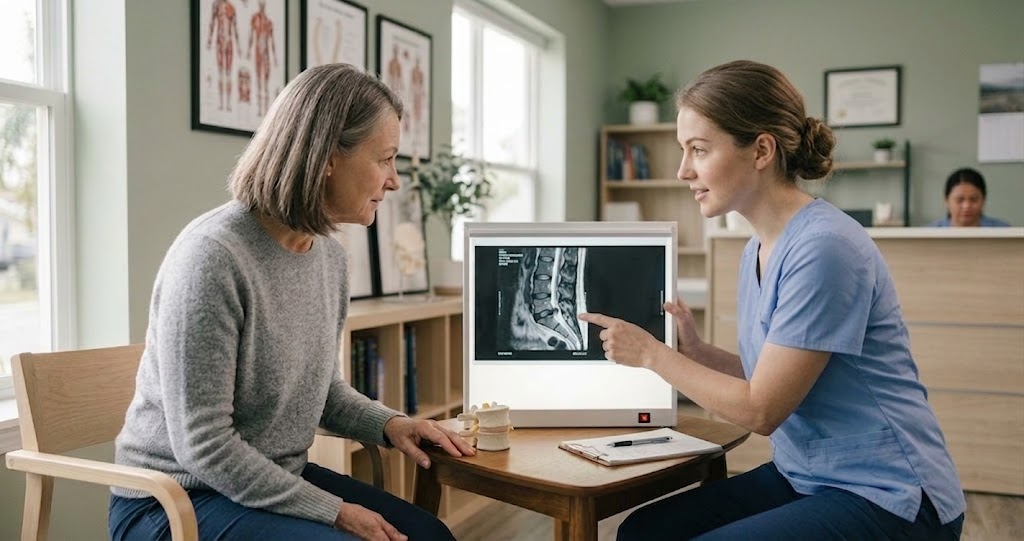
Yes. A normal MRI does not mean your symptoms are not real or that there is nothing to investigate. A standard lower-back MRI gives us detailed pictures of your spine, usually while you are lying still. It does not directly measure nerve function or show everything that happens when you sit, walk, or bend. Sometimes the sciatic nerve is irritated outside the spine, including in the deep buttock area near the piriformis muscle. Other conditions, such as hip or sacroiliac joint problems, can cause pain that feels like sciatica. A lower-back MRI may not fully evaluate those areas.
Why Can My Symptoms Be Real When My MRI Looks Normal?
Dr. Betty is direct about it: “Yes. A normal MRI does not mean your symptoms are not real or that there is nothing to investigate.” An MRI shows the structure of the spine in detail, but it is usually taken while you lie still, and it does not directly measure how your nerves are working or what happens when you sit, walk, or bend.
The link between images and symptoms is looser than most people assume, in both directions. In 160 patients with unilateral sciatic pain, MRI measures of disc displacement and nerve root compression did not correlate with subjective symptoms (Karppinen et al., 2001). And a meta-analysis reviewed in a 2019 BMJ article reported disc protrusion on MRI in 57% of people with symptoms and 34% of people without (Jensen et al., 2019). A scan is useful evidence. It is not a verdict on your pain.
Can the Sciatic Nerve Be Irritated Somewhere a Lower-Back MRI Doesn't Look?
It can, including in the deep buttock area near the piriformis muscle. The wider term now used is deep gluteal syndrome, describing sciatic nerve compression in the deep gluteal space by the piriformis or other structures. The British Journal of General Practice editorial estimates that between 6% and 17% of patients seen in secondary care with sciatica meet the diagnostic criteria, while cautioning that difficulties with case definition may have led those studies to underestimate it (Hopayian & Heathcote, 2019). A StatPearls reference puts piriformis syndrome at roughly 0.3% to 6% of low back pain and sciatica cases (Hicks et al., 2023). The numbers differ because the settings and definitions differ, and the honest summary is that it is real, not rare enough to ignore, and not common enough to assume.
The pattern clinicians look for includes buttock pain, pain that is aggravated by prolonged sitting, and tenderness on deep palpation of the buttock. The straight leg raise test may or may not be positive, so it does not reliably separate this from spinal sciatica (Hopayian & Heathcote, 2019). That is the kind of detail an examination can pick up and a lower-back MRI cannot.
Can Hip or Sacroiliac Joint Problems Cause Pain That Feels Like Sciatica?
Dr. Betty says yes: problems in the hip or the sacroiliac joint can produce pain that feels like sciatica, and a lower-back MRI is not designed to evaluate those areas fully. The editorial makes a related point about the difficulty. Several different pathologies can cause sciatica-like pain, and they cannot always be distinguished clinically (Hopayian & Heathcote, 2019). Telling them apart takes history, examination, and sometimes different testing, which is why "normal" on one scan is where the evaluation continues rather than ends.
What Does Dr. Betty Ask and Examine When Your MRI Is Normal?
To narrow down the cause, she asks:
- Exactly where your symptoms travel
- Whether you have shooting pain, tingling, numbness, or weakness
- What makes them better or worse
Then she examines you and checks your nerve function. Depending on those findings, additional testing or a referral may be appropriate. Her summary of the role of the scan is simple: “Your MRI is one part of the evaluation. We need to consider it alongside what you are experiencing and what we find on examination.”
Which Symptoms Can't Wait, Even With a Normal MRI?
A normal MRI is not a reason to ignore new warning signs. The red-flag list applies whatever the report says.
Get medical care now if you have:
- New or worsening leg weakness, including a foot that starts dragging or trouble lifting the front of your foot
- New difficulty urinating, loss of bowel or bladder control, or numbness around the groin, genitals, or inner thighs (the saddle area)
- Severe or worsening weakness or numbness in both legs
- Sudden major loss of feeling in your leg
- Back pain with fever, chills, or feeling generally unwell
- Unexplained weight loss alongside persistent back pain
Those symptoms call for immediate medical evaluation, not a scheduled chiropractic visit. Go to an urgent care or emergency room, or call 911 if symptoms are severe.
Short of that list, a normal MRI with ongoing symptoms is a schedule-an-evaluation situation. A practical first step is to take the OKC Sciatica Check at OKCSciaticaCheck.com, which helps you organize what you are feeling before your visit.
How Is a Normal MRI as the End of the Story Different From a Normal MRI as One Part of the Evaluation?
| Normal MRI as the End of the Story | Normal MRI as One Part of the Evaluation |
|---|---|
| Concluding the pain is not real | Recognizing the symptoms are real and still need explaining |
| Assuming the spine is the only possible source | Considering the sciatic nerve outside the spine, including near the piriformis, and hip or sacroiliac joint problems |
| Trusting a lower-back MRI to cover the buttock, hip, and pelvis | Remembering that a lower-back MRI may not fully evaluate those areas |
| Describing the pain in general terms | Pinning down where symptoms travel, what they feel like, and what makes them better or worse |
| Stopping at the report | Examining you and checking nerve function, then considering additional testing or a referral if findings call for it |
Both start from the same report. Only one keeps asking.
What Should I Do Next if My MRI Is Normal but My Leg Still Hurts?
Do not let the report close the question. Write down where your symptoms travel, what they feel like, and what makes them better or worse, and check yourself against the red-flag list. Bring the written MRI report and, if possible, the images on a CD or USB drive, along with notes on what you have already tried. If the symptoms are worsening, or they are interfering with your sleep, walking, work, or daily activities, schedule an evaluation. You can call or text the office, or book online, and the team is glad to answer questions before you schedule anything.
Take the Next Steps at OKCSciaticaCheck.com
A normal MRI can feel like a door closing: nothing to see, nothing to treat. But your symptoms are still information, and normal only answers one question. Finding the next one to ask starts with someone listening to where it travels and examining the nerve itself.
- Precision Care Chiropractic — 5850 W Wilshire Blvd, Oklahoma City, OK 73132
- Call or text: (405) 803-8770
- Book online: precisioncarechiropractic.com/new-patient-form
- Take the next steps at OKCSciaticaCheck.com.
References
- Hopayian, K., & Heathcote, J. (2019). Deep gluteal syndrome: an overlooked cause of sciatica. British Journal of General Practice, 69(687), 485–486. https://doi.org/10.3399/bjgp19X705653
- Karppinen, J., Malmivaara, A., Tervonen, O., Pääkkö, E., Kurunlahti, M., Syrjälä, P., Vasari, P., & Vanharanta, H. (2001). Severity of symptoms and signs in relation to magnetic resonance imaging findings among sciatic patients. Spine, 26(7), E149–E154. https://pubmed.ncbi.nlm.nih.gov/11295915/
- Jensen, R. K., Kongsted, A., Kjaer, P., & Koes, B. (2019). Diagnosis and treatment of sciatica. BMJ, 367, l6273. https://doi.org/10.1136/bmj.l6273
- Hicks, B. L., Lam, J. C., & Varacallo, M. A. Piriformis Syndrome. StatPearls [Internet]. National Center for Biotechnology Information, National Institutes of Health. Updated 2023. https://www.ncbi.nlm.nih.gov/books/NBK448172/
Frequently Asked Questions
Can I have sciatica if my MRI is normal?
You can have sciatica-like symptoms with a normal MRI. An MRI shows the spine in detail but does not directly measure nerve function, and the sciatic nerve can also be irritated outside the spine. A 2019 editorial notes that routine MRI fails to demonstrate the cause in as many as 49% of patients with sciatica (Hopayian & Heathcote, 2019).
Does a normal MRI mean my pain is in my head?
No. A normal report does not make your symptoms any less real, and it does not mean there is nothing to investigate. Research has found that MRI measures of disc displacement and nerve root compression did not correlate with subjective symptoms in patients with sciatic pain (Karppinen et al., 2001).
What else can cause sciatica-like pain besides a disc?
The sciatic nerve can be irritated outside the spine, including near the piriformis muscle in the deep buttock, and hip or sacroiliac joint problems can cause pain that feels like sciatica. Neither area is fully covered by a lower-back MRI.
How common is it for an MRI to miss the cause of sciatica?
Estimates vary, and they should be read carefully. A 2019 British Journal of General Practice editorial states that MRI as routinely practised fails to demonstrate the cause in as many as 49% of patients with sciatica (Hopayian & Heathcote, 2019).
Isn't a normal MRI good news?
It can be, because it makes some serious structural problems less likely. But it does not explain symptoms that are still there. Take the OKC Sciatica Check at OKCSciaticaCheck.com to organize what you have noticed; an evaluation is how the next question gets asked.
What happens at Precision Care Chiropractic if my MRI is normal?
Dr. Betty asks exactly where your symptoms travel, whether you have shooting pain, tingling, numbness, or weakness, and what makes them better or worse. Then she examines you and checks your nerve function. Depending on those findings, additional testing or a referral may be appropriate.
Which symptoms can't wait, even if my MRI is normal?
New or worsening leg weakness, including a foot that starts dragging, needs urgent medical evaluation. New difficulty urinating, loss of bowel or bladder control, or numbness around the groin, genitals, or inner thighs calls for emergency evaluation. Back pain with fever, chills, or feeling generally unwell needs urgent medical assessment.
This article is for educational purposes only and is not medical advice, diagnosis, or treatment. It does not establish a doctor-patient relationship and does not guarantee any outcome or result. Individual results vary. Only an in-person evaluation by a qualified provider can determine what may be contributing to your symptoms and what care, if any, is appropriate for you. If you are experiencing any of the red-flag symptoms described in this article, seek immediate medical evaluation.
Ready for a Reasonable First Step?
Use the free, non-diagnostic Next-Step Checker, or call Precision Care Chiropractic in Oklahoma City to ask about an in-person evaluation.
Keep Reading

Can You Have Sciatica Even if You Barely Have Lower-Back Pain?

Do I Need an MRI Before Anyone Can Tell Me What to Do Next for Sciatica?

Is an X-Ray Useful for Sciatica, or Do I Really Need an MRI?